
Similar Posts
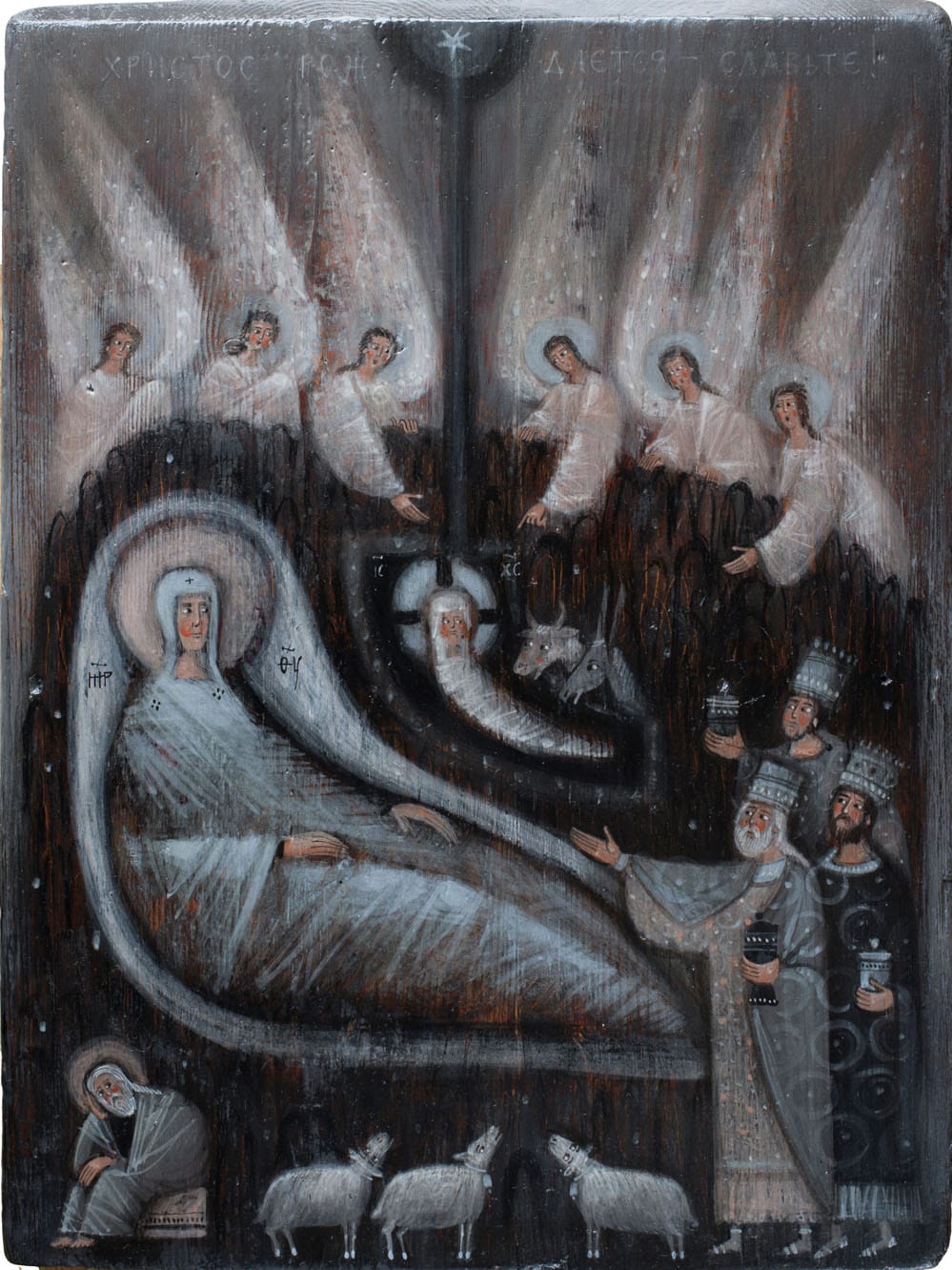
The Nativity of Christ by Olga Shalamova, 2025. Aged wood, egg tempera.
In this work, I was fascinated to watch the image literally emerge from the dark surface of the panel. In icon painting, we very, very often paint both faces and garments from dark to light, as though drawing the image out of nonexistence. Here, the dark wood of the old panel literally became the mysterious atmosphere of Christmas night.
What I like about working in this way is that you are not thinking about formal approaches in icon painting; you are thinking about the image itself, about the composition as a whole.
This article was originally published in the magazine “Slovo i Kamen” (“Word and Stone”).
Icon Painter and Artist
From book to book, from trip to trip, from one person to the next, encounters keep happening – and each time something important comes into view. For me, one of the most meaningful was meeting Todor Mitrovic. It was in the fall of 2010, when St. Petersburg hosted an icon-painting symposium organized by Georgios Kordis. Artists came from Romania, Serbia, and Bulgaria; and there were Russians too: Philip Davydov and myself, along with Zhenya Davydenko and Yaroslavа Alekseeva. The artists were invited for three days, during which they worked on monumental compositions. The event was open to the public—people could drop in and watch the process. But the best part was talking with one another, and that turned out to be priceless.
What struck me in Todor’s work was the realization that a contemporary icon does not have to be a frozen mannequin, some kind of “proper” mask—it can be deeply sincere, naive, and joyful. These were not copies or stylizations; they were icons, but different from any I had seen before. What won me over most was that he was a true artist. The very term “icon painter” often imposes limitations, cutting off the creative process, but here I saw an icon painter and an artist in the fullest sense.
The atmosphere of the symposium was extraordinary as well, and we have all remained friends ever since. Later, I interviewed Todor for the almanac Gifts. He spoke fascinatingly about the nature of the canon, referring to the Apostle Paul: originally, “canon” was understood as a measure of piety, and only over time did it acquire external boundaries and rules.
For all my affection for Todor’s work, I try not to get carried away with borrowing particular formal approaches. What I did take from him was a sense of freedom in working with the icon—a freedom grounded in tradition and in the understanding that tradition has always been fluid and has always reflected its time. For me, icon painting is a high art—one that you cannot truly enter unless you are an artist.
The Philosophy of the Creative Process and the “Miracle” of Making Art
The eternal question for any artist is how not to become rigid in the approaches one has discovered and, perhaps without even noticing it, begin to repeat oneself. Why does one artist stop searching and start reproducing their own solutions, while another continues to create something new throughout their life and remains curious about the world?
I think what matters most here is that moment of genuine wonder—the ability to see something new, to learn, to make mistakes, even when you are eighty or ninety years old. What matters is a sense of the creative process as something alive, along with an awareness of your own imperfection. And perhaps it is also important, like the ancient Chinese painters, to switch the brush from your right hand to your left when you feel yourself beginning to work mechanically.
Creativity as Daily Routine
For me, creativity is first and foremost daily work. Inspiration never simply appears on its own. First, you have to enter the process, the routine itself. You simply come into the studio and begin to work, and gradually you enter a kind of state of flow in which everything becomes logical and clear. This state does not descend upon you—you have to enter it yourself. But at the same time, this does not mean that everything comes in a single breath or that you never make mistakes.
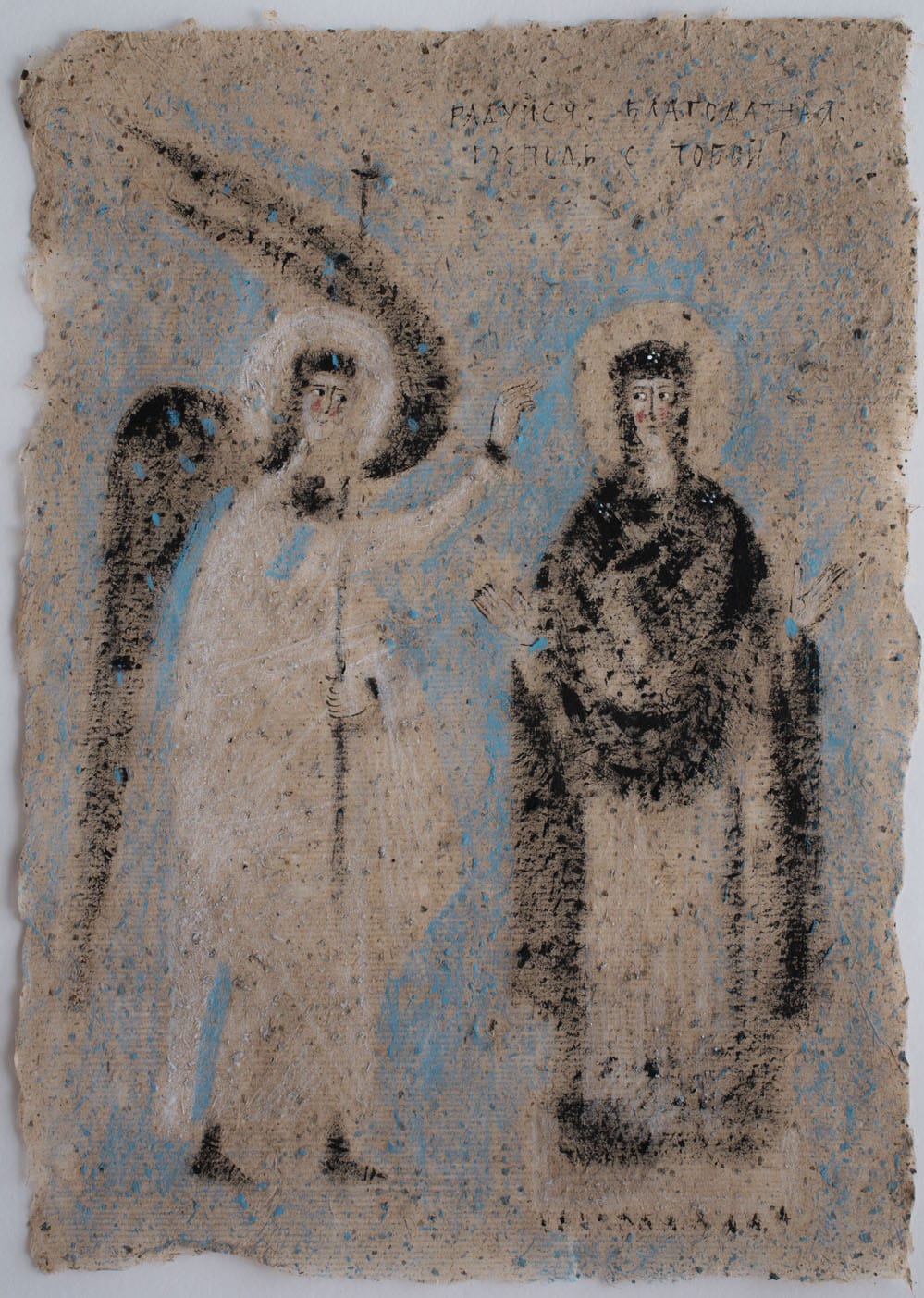
The Annunciation to the Mother of God by Olga Shalamova, 2025. Handmade mulberry paper, mixed media.
Panels and tiles are substantial, heavy supports that require both special preparation and proper storage. So discovering handmade mulberry paper as a surface to work on was a real find for me. It is thin and uneven, with areas where the layer becomes thinner and even small bare patches. There are all kinds of hard inclusions and irregularities, and I find the character of this surface fascinating.
Whatever material I work with, I greatly value its individual character. I don’t want to neutralize or correct it; on the contrary, I want to feel it and bring it out, because the surface itself can already determine the expressive quality of the image.
Here, I particularly enjoyed working with a dry, coarse brush and seeing the uneven, lively brushstroke it produces. I make works like this without a preliminary drawing, working boldly and freely from the very beginning. There is almost no possibility of making corrections, and I like that very much, because I think the energy with which the work is made is transmitted to the viewer.
The surface of the paper itself does not allow you to become absorbed in detail, and in this way the material itself leaves the viewer space for co-creation.
For a while, those mistakes in my work—when I reached a dead end and did not know what to do next, when I redid something several times and the work still refused to come together—upset me deeply, and I experienced such moments very intensely, until I realized that this is the very essence of my work: these dead ends are always fascinating, and they are always points of growth.
I can’t say that I deliberately wait for such moments, but when everything falls apart—the composition collapses, the color doesn’t work the way I intended, or some other problem arises—I see it as the best moment in the process, and I have come to love this state.
This is precisely when you become fully engaged, mobilizing all your knowledge, experience, and strength. You look at the failure and think: interesting—how do I find my way out of this maze? You are already inside the process, but standing among the ruins, and how it all comes together depends entirely on you. And to me, this says something very important about the work of an icon painter.
As long as we are making mistakes, searching, and reworking things, there is definitely something real in our work—something we have had to struggle for, even if only a little.
There are countless videos online in which an icon painter appears as an inspired creator who walks up to a wall or a panel and immediately produces a masterpiece. This is certainly beautiful, but it is only a screen concealing the real, difficult work—the work in which you stumble, doubt yourself, redo things, and keep going. And that is normal. It is part of the process.
On Canon, Tradition, and Boundaries in Church Art
For an icon painter, reflecting on canon and on the limits of what is permissible in church art is an ongoing process. I was once asked how acceptable it is to place very avant-garde icons—such as those of the Lviv school—in an Orthodox church. They seem to be icons, and yet somehow they seem strange. So what do we do with that?
I do have an answer to this question, but I can only offer my own perspective, based on a kind of ideal situation. Let us imagine an ideal world: the parishioners of a particular church commission icons from Lviv artists because they themselves are able to decide what kind of space they want to pray in. And they want to pray surrounded by precisely these images because, for these particular people, this art is liturgical; it is in images like these that they see Christ most clearly. In that case, who are we to forbid them?
To question whether particular icons have a legitimate place in a church seems to me somewhat presumptuous. We want to reduce all church art to a handful of rules. For some reason, we find it difficult to accept, deep down, that we are all very, very different. For one person, an icon has to be dark and old, set in a gilded frame; for another, it is a reinterpretation of Old Russian icons; for someone else, it is the imagery of Jerzy Nowosielski. We are all different, and we can attend different churches where, perhaps one day, the visual language will differ as well. And it seems to me that the fact that we are all so different is a tremendous gift.
This urge to regulate everything is a huge problem of our time—and, in particular, of the discourse surrounding the icon.
For me, this desire to make everything uniform and to define what an icon should be carries clear echoes of the Soviet era. I believe that it is the community, and the community alone, that can and should decide. And if, out of a great many Gospels, not one, not two, but four were chosen, that is a good example for us of how to be more tolerant in our judgments about what is permissible in an icon and what is not.
It is wonderful when a community has its own icon painter. Suppose that in my community, besides me, there is another artist who paints icons for my church—I would be very happy about that. Even if his approach were not particularly close to my own, it would still be deeply satisfying, on a human level, to know that this work was born within the community, that I know this icon painter and everyone around me knows him as well.
Perhaps these icons would not be perfect and would not meet certain so-called “high standards,” but if they are accepted by the community, why should someone come in and say, “Look, these are bad icons—or bad murals—tear them down at once”?
When we talk about the path of young icon painters and their search for a visual language of their own, I don’t think that everyone necessarily has to be “creative.”
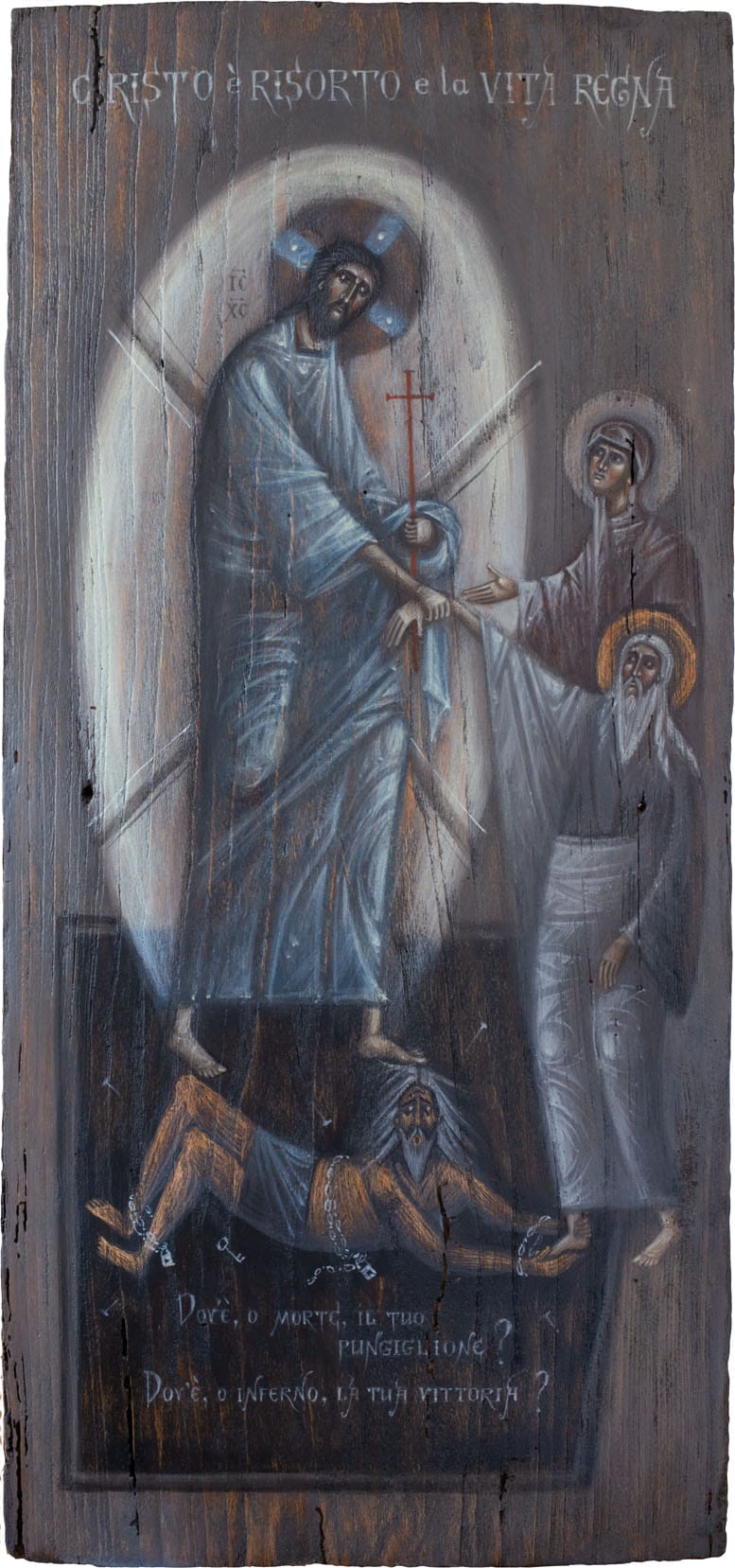
The Resurrection of Christ by Olga Shalamova, 2024. Old ceiling panel, egg tempera.
In every work, it is important for me to think about how the meaning of the image is revealed through composition, color, and details. Here, everything is built on the juxtaposition of two geometric forms—the oval and the rectangle: the rounded mandorla, in whose radiance Christ is depicted, and the rectangle of hell. On the one hand, it is a very simple visual idea, but it is precisely this simplicity that leaves space for reflection.
Instead of the familiar title “The Descent into Hell,” I wanted the icon to proclaim the Victory of Life. The phrase “Christ is risen, and life reigns” comes from the Paschal Homily of St. John Chrysostom, which is read in churches on the night of Pascha. The words of the Apostle Paul are heard there as well: “O death, where is your sting? O hell, where is your victory?” (1 Cor. 15:55).
Such an inscription does not simply accompany the image—it expands its field of meaning and makes the inner dialogue with the image deeper and more personal.
We are born with certain gifts. We are all very, very different, and I think our task is not to invent something new, but to discover within ourselves what has already been given to us.
If you make beautiful copies, then perhaps that is your gift. And that, too, can be a genuine form of service. Above all, it is important to learn to listen to yourself and truly hear yourself. Because only through this inner honesty is a genuine conversation with God possible.
There is a great deal of emphasis on obedience in church life, and it is indeed important. But no priest can look inside your soul and determine your calling for you. For me, this is precisely what Christianity is about: personal responsibility before God and inner freedom.
Does the Personality of the Icon Painter Matter?
For me, everything that concerns canon in icon painting consists of very formal, basic things. It is a foundation, and that foundation can be filled in very different ways. Contrary to the widespread idea that the personality of the icon painter does not matter, I believe exactly the opposite: the personality of the artist-icon painter is fundamentally important. What matters to us is hearing a living testimony to Christ, not a dull retelling in which the speaker periodically loses the thread of thought.
For some time now, I have been surprised by how completely our personality reveals itself in our work, whether we want it to or not. You can sense very clearly, for example, the personality of someone who has taken a defensive position in icon painting: how constrained and angular the work becomes, how careful and meticulous the artist is, how afraid of making a mistake, how diligently everything is done.
Or, conversely, you may see someone working with extraordinary virtuosity and yet somehow feel that something is missing within. Or you may see, throughout an artist’s work, an obvious desire to please—a desire that practically cries out. Or you may encounter concentrated stillness and the joy of meeting Christ.
However banal it may sound, Flaubert’s “Madame Bovary is me” applies to every form of art.
And everything we are told about the anonymity of icon painters seems to me largely invented. Historically, we know that church paintings were signed. In Georgia, for example, I know that the fourteenth-century paintings at Tsalenjikha are signed; we also know the twelfth-century master Tevdore, a royal painter who worked in at least four churches in Svaneti. There are other names as well—we simply take too little interest in them.
Christianity places the person at its center because at its foundation stands God who became man.
Christianity is not abstract—it is personal. At its center stands the human person as the image and likeness of God. Whatever we create inevitably bears the imprint of our personality.
And I think this is precisely where the value of all art lies—including the value of icon painting.
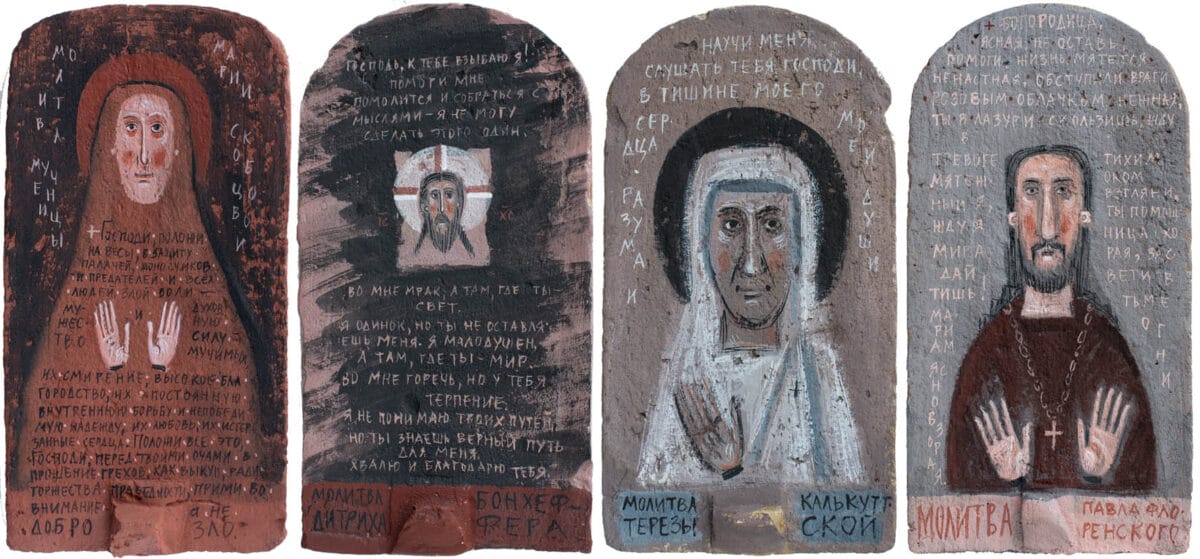
Prayer of St. Maria Skobtsova, Prayer of Dietrich Bonhoeffer, Prayer of St. Thérèse, Prayer of Pavel Florensky by Olga Shalamova, 2025. Works from the “Prayer” series, painted on old roof tiles. Old roof tile, egg tempera, 2025.
For several years now, I have been using old roof tiles as a support for painting. The reverse side, which I paint on, is very uneven and rough and closely resembles the surface of a wall.
I paint different subjects on these tiles. The idea of depicting saints and people who have not been canonized together with words from their prayers arose quite naturally while I was making a small series of illustrations for a book of prayers.
But how can you illustrate the words of a prayer?
I began thinking about how praying figures were represented in Early Christian art—the Orans, with arms raised and outstretched—and decided to depict the authors of the prayers themselves in gestures of prayer.
Some of the prayers moved me deeply, and at first I kept trying to fit almost the entire text into a single image. Eventually I realized that it was not necessary to include everything—that a short phrase could be enough to reveal something new about the person.
For me, bringing the living word into the image became very important. I feel that it adds enormously to the image itself.
It also turned out that the prayer attributed to Maria Skobtsova was mistakenly attributed to her. But I decided not to correct the work, because the image I painted is not a portrait. It is highly generalized—simply an image of a soul at prayer.
The Icon as Art
The term “authorial icon” is very popular today. There is even a certain opposition between icon painters of a traditional orientation—those who have chosen one or several historical styles and work with their eyes turned toward the past—and those who seek to discover the image anew.
Accordingly, each “camp” has its own appeals and arguments: traditionalists condemn icon painters of the “creative” tendency, while artists associated with the “authorial icon” speak about the advantages of an individual artistic approach. In one way or another, everyone defends their own position.
As I said earlier, I find the idea of choosing a single path that everyone is supposed to follow very strange. I respect artists from different “camps.” For me, the main criterion is the artistic quality of the icon. When we speak about icons from within the profession, after all, we are speaking not only about a sacred object but also about its visual and artistic dimension.
What matters most to me in an icon is not its style or authorship, but how competently you, as a professional artist, do your work. To what extent does your work—constructed from areas of color, lines, combinations of colors, and internal movements—become art? What do you, as an artist, put into the work, and how do you do it?
This is the most important question, and yet it is almost entirely absent from discussions about the icon. We talk about style, tradition, canon, and many other important things, but we never talk about the artistic qualities of the image. That dimension has been excluded from the discussion of icon painting.
And this, it seems to me, is where the real dividing line lies—not between “traditionalists” and “avant-gardists,” but in whether we are prepared to speak about the icon as art.
Curiously, many people think that if you reproduce an ancient work carefully and literally, you will end up with exactly the same icon. But unfortunately—or perhaps fortunately—it doesn’t work that way.
What matters enormously is what you actually see when you look at that work. Do you see only the surface and the sequence in which the layers were applied? Or do you see how the areas of color and the silhouette of the figure work? Do you see where the artist creates tension and where they introduce pauses? Do you see how the artist leads you through the image—what they allow you to notice, where they make your eye stop and perhaps even focus, and what they deliberately suppress and push into the background?
To make a good copy, you need to understand the laws of composition and how color and tone work. Art is always built on countless nuances: one small inaccuracy, and instead of a masterpiece you end up not simply with an ordinary work, but with a helpless one.
People rarely explain that behind a smoothly painted face and beautifully rendered folds there must also be something with which you fill the work—there must be an idea and your own creative effort.
Today, however, more and more attention is paid to the technical finish of the work. This has become a kind of measure of quality.
The garments are beautifully painted; the transitions from shadow to bright, luminous color are beautifully handled. Details certainly matter, but every detail must serve the integrity of the image, the integrity of your idea.
Very often that inner idea is missing. As a result, we get works that are outwardly executed with great correctness, but what they show us is not so much Christ or the saints as how beautifully the icon painter can paint the folds of a garment or model the transitions of color in a face.
What I often miss in contemporary work is precisely this inner conception—the foundation that makes a dialogue with the image possible. That is why I believe icon painting must be art.
Church Space as an Event
Unfortunately, today very little thought is given to the integrity of the church interior. The space is perceived as a collection of objects rather than as a single artistic whole. And yet what matters in a church is not material richness or the number of expensive objects, but a carefully considered solution—one developed jointly by the artist and the architect.
A church is not a warehouse of pious objects. Everything brought into it should be connected by a common logic and should serve to reveal the liturgy. In essence, church space is a particular kind of scenography. It unfolds within a given architecture and requires attention to many nuances: light, scale, rhythm, and the sequence in which the space is perceived.
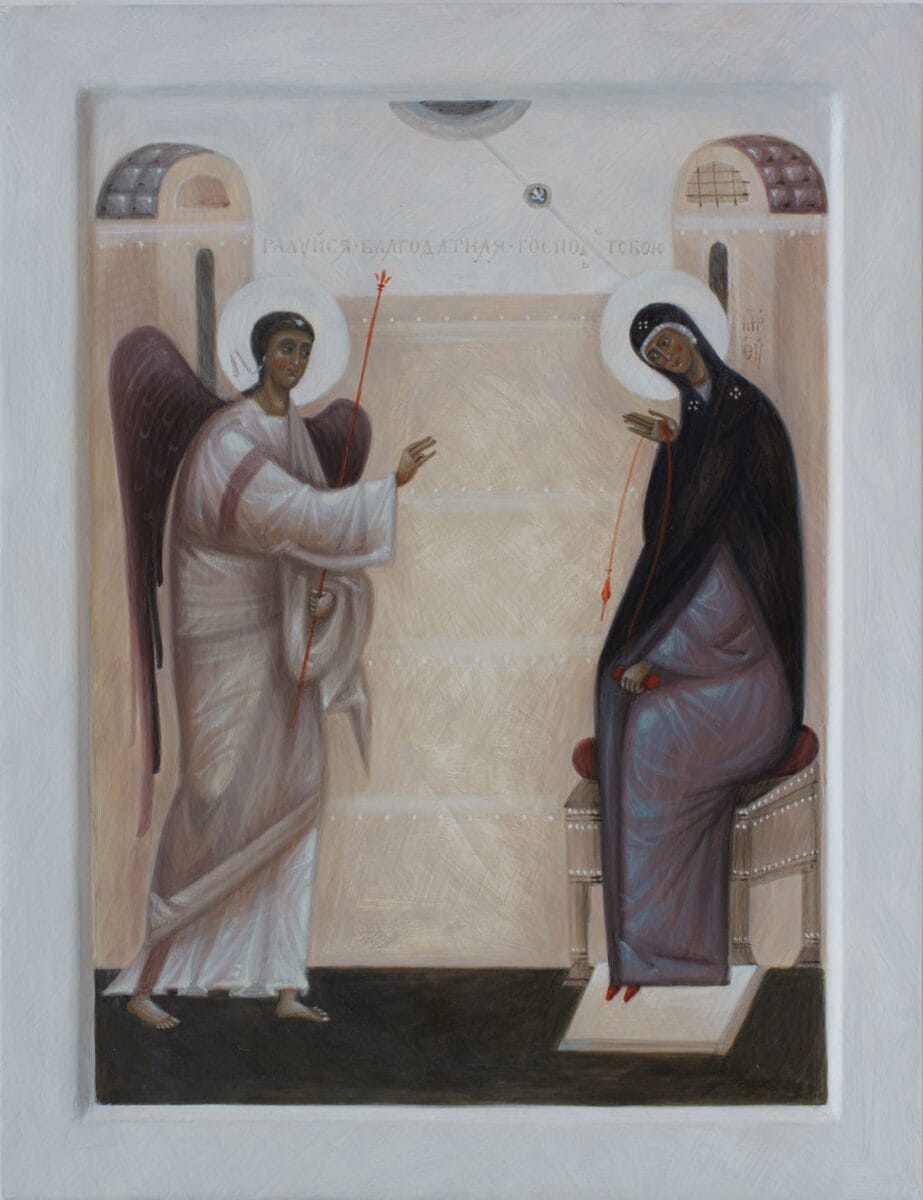
The Annunciation to the Most Holy Theotokos by Olga Shalamova, 2025. Wood, gesso, egg tempera.
I painted this Annunciation icon during classes for icon painters. I wanted to show how much variation is possible when working with the very same composition. Before moving on to the final version—and everyone developed their own—we took a close look at how the composition is constructed.
The greatest revelation for me was realizing that, in an icon, it is not the figures that are placed into a pre-existing space—the logic is exactly the opposite: the architecture is built around them. And this happens every time, whatever composition we take. Architecture—or a landscape setting—becomes a kind of visual accompaniment to the main subject.
Today, however, the opposite often happens: the church is simply filled because “that is how it is supposed to be.” More and more objects are added, without any internal hierarchy or understanding of how this space will speak to a person.
As a rule, I find it difficult to be in a contemporary church interior, especially one that has been lavishly “beautified.” When I enter, I can physically feel the force with which the murals, icons, carvings, and countless different objects come at me—and everything demands my attention, everything competes for it.
I am particularly struck by the fact that there never seem to be enough icons. I often see a hand-painted icon gradually surrounded by paper reproductions… Everything is pious, but… empty.
The absence of an artist thinking about the unity of the church space is like the absence of a foreman on a construction site.
It may seem that the foreman is doing nothing, but remove him and nothing comes together. In the same way, in a contemporary church I often feel a profound dissonance between the mystery of the Liturgy and the environment in which it takes place. For me, it is usually simply a great many pious images.
But when you enter an ancient church, it too may be completely covered with paintings, and yet you feel remarkably at ease within it. I feel most comfortable in ancient churches preserved as museums, where, for example, there are only the original frescoes and no other additions. For me, such a space is deeply conducive to prayer. It is a place of encounter with God, even outside the Liturgy. You simply enter and experience something absolutely extraordinary.
Art in a church—especially good art—is extremely important, because it is something as mysterious as the Incarnation.
I have often wondered what art is for me. There are countless images. Some of them will always remain simply images, while others we can call art. What is the moment when that happens?
Perhaps it is the moment when the most ordinary things—pigments, binders, various materials—give birth to something greater than the sum of their parts. When simple elements come together and suddenly create an image or an experience capable of awakening an inner response in another person. And in the case of an icon, of leading you from the image to the Prototype.
Paints and tools in themselves are only matter. But the artist brings them together in such a way that something immaterial is added to this material layer. Another dimension appears—that intangible substance through which a work begins to speak to another person, to touch their feelings, to awaken an experience within them.
And perhaps this is precisely what art means to me: the ability to touch the immaterial through the material.
A poet writes poetry using the most ordinary words—the same words we use every day.
And yet suddenly the poet brings them together in such a way that they cease to be ordinary, everyday words. A tension arises between them; images emerge and flow into one another, opening up a new space and new meanings for the reader.
The words remain the same—but their combination creates an event.
Essentially, the same thing should happen in a space conceived by an artist. The artist works with ordinary things—walls, light, colors, objects. But when they are brought together meaningfully, when there is an inner purpose behind them, what emerges is no longer simply an interior, but an event.
The space begins to reveal itself differently. It ceases to be a collection of elements and creates another world.
And there are no ready-made formulas for this. You cannot simply arrange objects “as is customary” or “because that is how it is supposed to be.” This requires a high degree of competence—both artistic and spiritual. It requires an understanding of the task you are setting yourself.
It is one thing to say, “This should go here, and that should go there, because that is the rule.” It is quite another to enter a newly built church and ask yourself: the Liturgy will be celebrated here—how will it unfold? What needs to be done so that a person can feel that a mystery is taking place? How should the space be conceived so that it guides, gathers, and reveals the meaning of the liturgy?
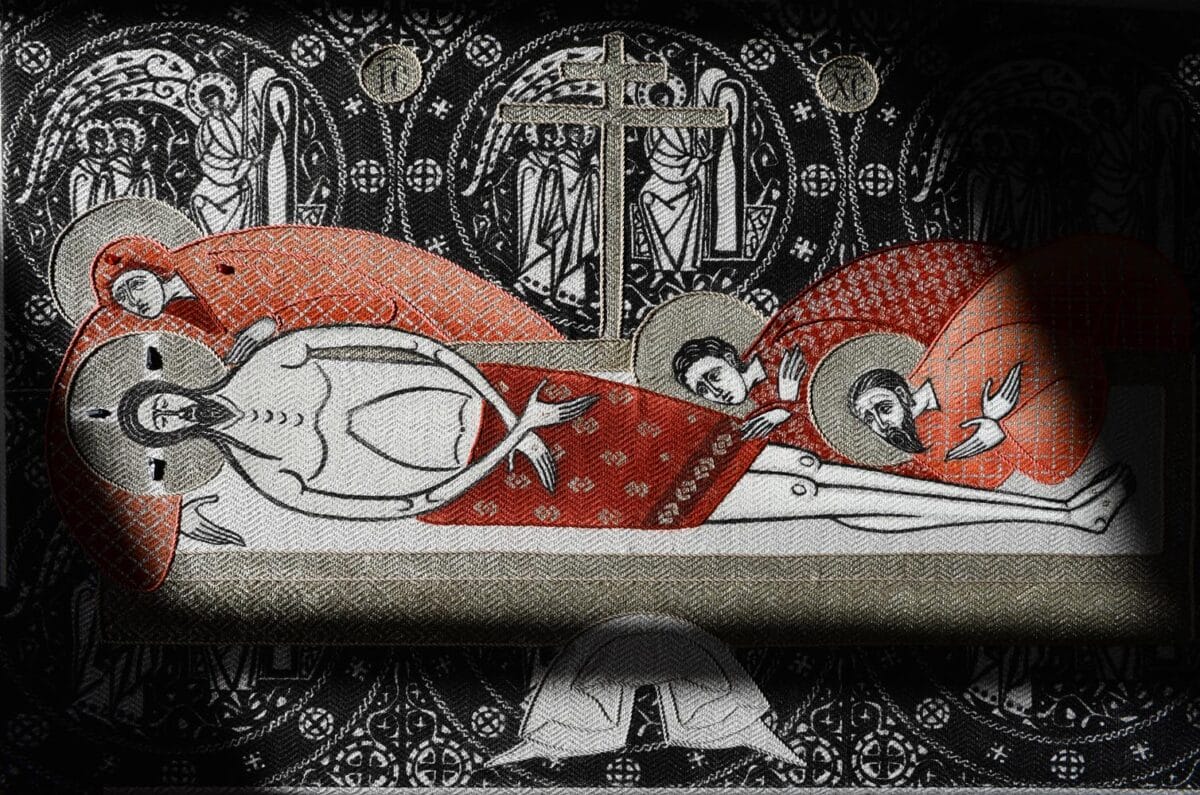
Epitaphios by Olga Shalamova, 2019. Linocut and stencil printing, embroidery, oil and textile paints, pearls and decorative stones, threads.
Technically—especially compared with traditional goldwork embroidery—the Epitaphios is made quite simply: block printing, stencils, and a bit of cord stitching. I’ve long loved how, in early embroidery, the artist works with the background fabric. That’s something we can never really allow ourselves in an icon. We can’t suddenly let huge flowers or Eastern-style ornaments take over the background. In embroidery, though, they always knew how to “tame” them.
Gold and Light in the Contemporary Church
Today we follow the ancient tradition of gilding icons without considering that the conditions in which these icons exist in contemporary churches have changed.
We continue to gild icons because gold is a sign of divine light and, at the same time, a medium for that light—a surface capable of responding to the slightest change in illumination and creating a sense of depth and movement within the image.
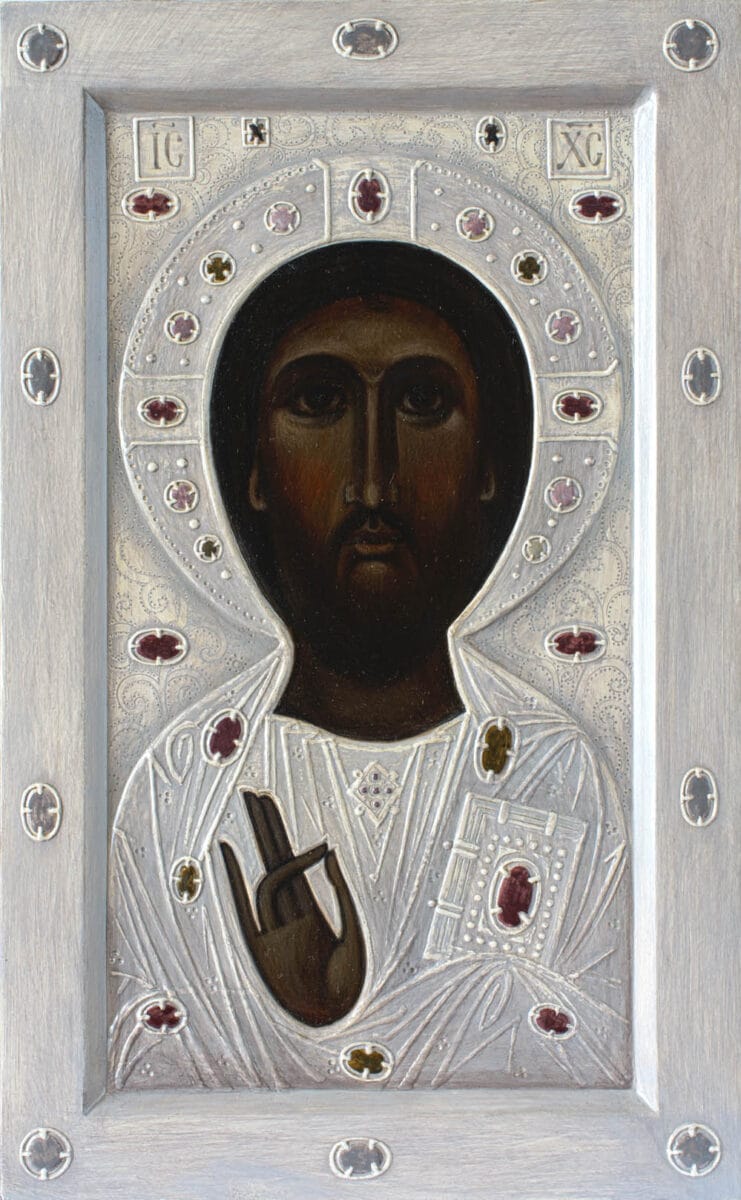
The Anchiskhati Savior, 2025. Wood, gesso, relief gesso, egg tempera.
The starting point for this work was an ancient encaustic icon highly venerated in Georgia. Over time, the original painting of the Image of the Savior Not Made by Hands was covered by a metal revetment. The design of the revetment altered the iconography, and the image is now that of Christ Pantocrator.
An icon with a gold background was conceived for natural light, whether the brightness of midday or the gathering dusk. Depending on the light, the image could seem to disappear, suspended as a dark silhouette against the gold, and then emerge again. It was never the same, never static; it was full of movement and change.
I think the candles lit before icons created an additional sense of trembling, of the image being alive. There was a mystery in this.
But contemporary churches are flooded with electric light. When we bring in a gold icon and switch on bright lighting, the mystery that Byzantine and medieval Russian artists relied upon simply does not happen. Light fills everything evenly, and the glare of the gold strikes the eye.
The mystery disappears. Everything becomes flat and final, even somehow hopeless.
It turns out that gold does not work under electric lighting.
Today an icon needs to relate differently to the space of the church and to interact differently with light. This is precisely why, when designing church interiors, it is so important to plan different lighting scenarios. Light in a church is a mystical thing, and it should be considered no less carefully than the composition of the murals.
I feel this more and more strongly living in Georgia, where there is so much natural light. When I visit Kintsvisi, for example, where thirteenth-century paintings on blue backgrounds have survived, I see how light literally creates the space—light becomes a participant in its own right.
You arrive on a gloomy day and the church appears gray or dark blue; all the paintings merge into a single mass. Then the sun suddenly breaks through, and everything turns sky blue and separates into individual compositions. A ray of light moves across the wall, and the blue flares with even greater intensity.
At different times of day, the church lives differently. There is no single static, “correct” illumination for any composition. Everything is filled with movement.
I had read about this in books, but it remained dry knowledge. When you actually see it, it is mesmerizing. Each time you enter the same church, with the same paintings, you find yourself in a new space.
There is electric lighting there as well—I imagine it is used on overcast days… And that is the difference:
Artificial light fixes the image, while natural light allows it to live and change.
Does Church Space Have an Author?
Very often, the church space is shaped by the client—the person who pays and therefore dictates. Just as often, responsibility for the interior falls to the priest, who brings in different workshops, teams, or individual icon painters.
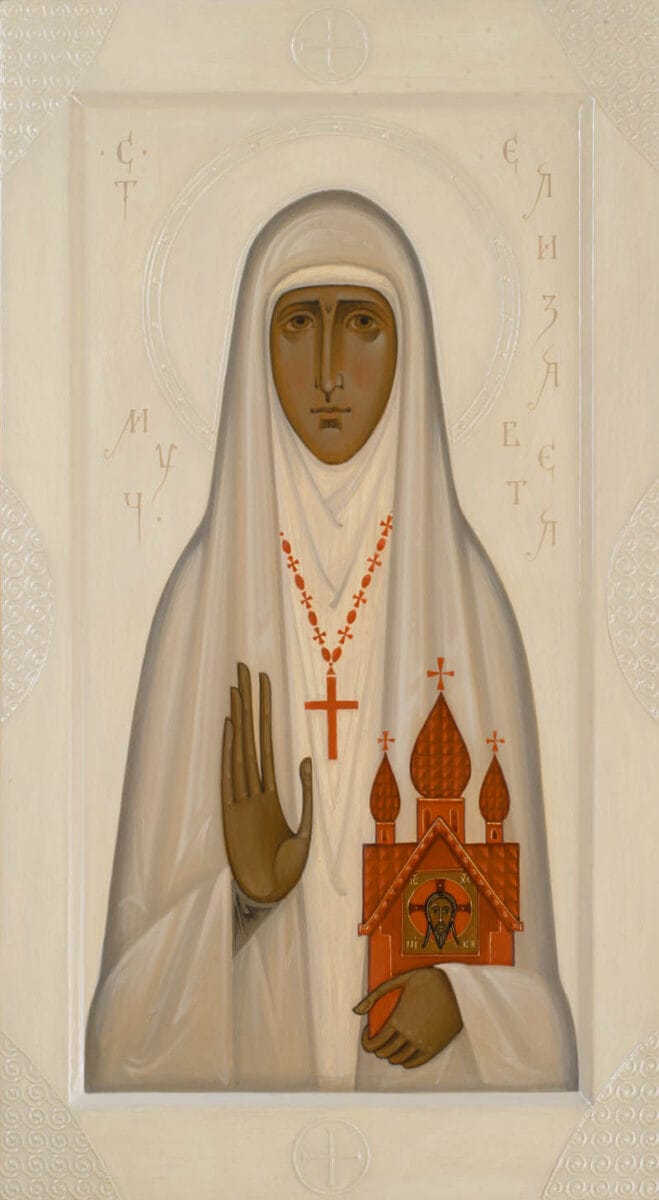
Holy Martyr Elizabeth Feodorovna by Olga Shalamova, 2017. Wood, gesso, relief gesso, egg tempera.
I have long been working with a light background as an alternative to traditional gold. Sometimes I incorporate small ornaments in relief gesso into the composition. Here they are intended to emphasize St. Elizabeth’s aristocratic character and inner refinement. Perhaps they even suggest, very subtly, the Art Nouveau period.
But as a rule, none of these people thinks of the space as a whole. Everything breaks down into separate tasks: the floor, the walls, the lighting, the icons, and so on. Only rarely is there someone capable of thinking through the entire interior.
I would say that a priest usually creates the interior according to his own personal taste, rather like renovating his own apartment.
Unfortunately, there is a great deal of distrust toward the icon painter’s professional judgment. Even an ordinary person is more likely to trust the opinion of a priest than that of an icon painter.
Let us be honest: a priest has a basic understanding of icon painting, but as a rule that understanding is quite superficial. A priest is, first and foremost, a theologian, a liturgist, a preacher; he does not understand how an image is created. Most priests simply do not have the professional expertise required to evaluate the work of an icon painter.
Recently I was in America, in a small Orthodox church built by Russian émigrés, probably in the 1950s. At the time, the community was large and the church was always full of people. The architect converted it from his own garage and, from the very beginning, carefully maintained the integrity of the space.
Very little has changed there since then, and today the interior is remarkably harmonious—perhaps more so than any other church interior I have seen.
The parishioners smile when they tell the story: whenever someone wanted to bring in something new or “improve” something, the architect took a fairly firm position and, as a rule, allowed nothing to be changed.
At first glance, the icons in this church are quite ordinary, nothing particularly remarkable if you look at them individually. But within the interior, their effect is multiplied many times over. And then you understand how precisely the icon painter sensed the space, and how precisely the architect understood the logic of the whole.
The space makes an extraordinary impression: it is deeply coherent and deeply liturgical.
Today there is an idea that anyone can bring an icon or some other gift into a church, and that the priest should somehow feel uncomfortable saying, “Thank you, but this is not right for us.”
But this requires a clear and firm position: “Thank you for your desire to serve, but a church is not a private home. We cannot accept everything that is offered to us.”
It is important to agree on such things in advance, while everything is still being discussed. Otherwise, an awkward situation arises: an icon is accepted out of politeness but is never actually placed in the church—and in the end, the person who donated it feels even more hurt.
At the same time, everything that has already become part of the church space should be treated with care. Once an object has entered the life of a church, it calls for respect and responsibility.
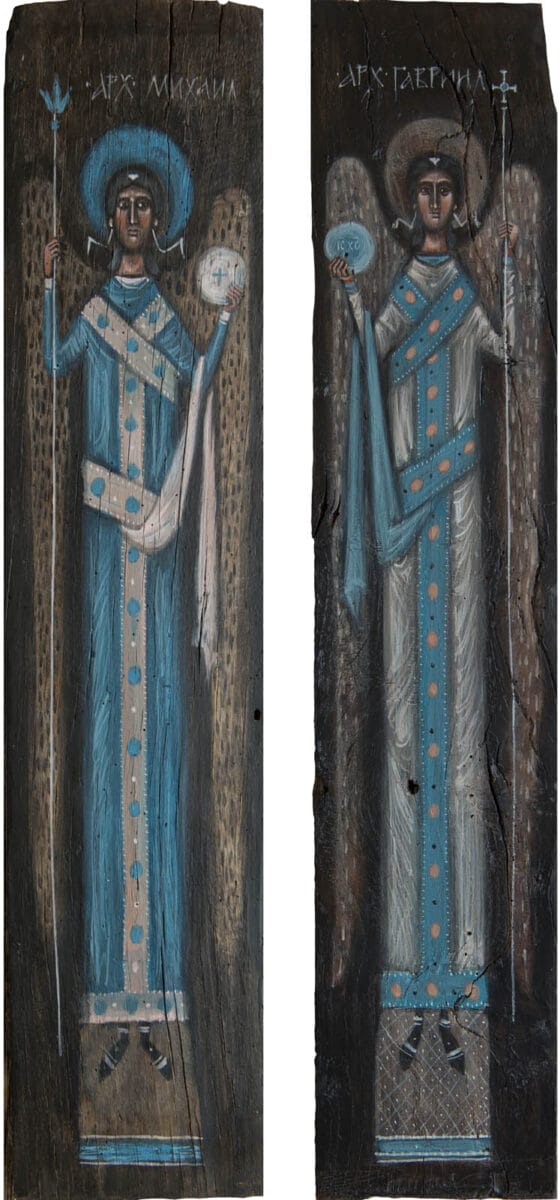
Archangels Michael and Gabriel by Olga Shalamova, 2022. Old wood, egg tempera.
I came across several pieces of old, worm-eaten wood, with cracks, chips, and even holes right through them. Even without any image on them, they were incredibly beautiful.
The original shape of the boards determined the images themselves: the Archangels seem almost to have stretched to follow their form.
Nothing was deliberately invented—I simply brought out what was already there in the material.
Contemporary Art in the Church
If we are going to talk about art in the Church, it seems to me that we need to begin not with art, but with the way the Church is administered.
In my view, the possibility for creative work largely closed off sometime in the early 2000s, when the authority of parish councils was severely restricted. The community lost its voice. Everything now depends on the priest.
And it seems to me that the Church is alive through us—living people.
It matters when people within a community come together and decide: shall we invite Smirnov, Petrov, or Ivanov to paint our church, or shall we leave it unpainted?
Instead, everyone waits anxiously for the bishop to arrive, because it is he who must approve—or reject—the space in which we come to pray. If that changes, perhaps living art will once again find a place in the Church.
Of course, even today there are many very good icon painters who manage to work – not so much thanks to official church commissions, but more in spite of them.
As a rule, when church authorities reject a work, the reason is not an iconographic or semantic distortion, nor an error in the representation of a Gospel scene or in its theological interpretation.
What causes objection above all is unfamiliarity—the freedom with which the image is interpreted.
For a long time, I have thought that someone should make a book about all the murals destroyed in recent years because they failed to pass the “filter” of church commissions. There is the church in St. Petersburg painted by Alexei Trunin, and the destroyed murals by Irina Zatulovskaya. Alexander Sokolov and Anatoly Komelin could be included as well… and many others.
Such a publication could become a monument to our time.
Living art enters churches… and is accepted by absolutely everyone except the church administration. For me, this is an image of our contemporary Church, rejecting everything that is sincere, alive, and powerful. Strangely enough, genuine art seems offensive and frightening to it, and so there is an attempt to get rid of it.
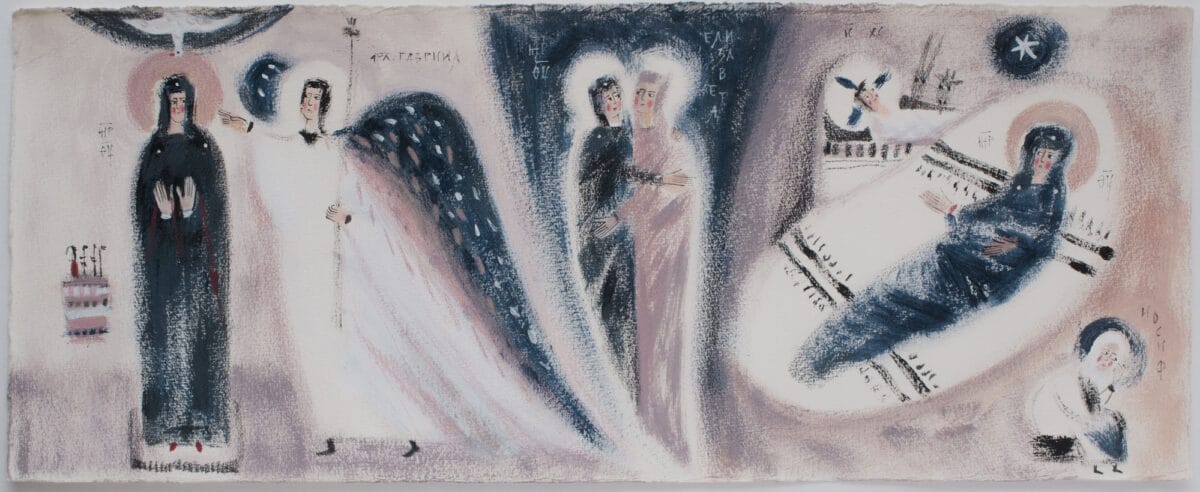
The Annunciation to the Mother of God. The Meeting of Mary and Elizabeth. The Nativity of Christ by Olga Shalamova, 2025. Paper, mixed media.
As a rule, all my works on paper grow out of direct encounters with ancient monuments. It is very important for me to see frescoes and icons in person, because even the best photograph cannot replace that immediate experience. Suddenly you discover that something that looked enormous in a photograph is actually quite small; or, conversely, you suddenly see how a composition comes alive on a curved surface, and you are able to study the painting itself more closely. Frescoes, for example, are very often badly damaged and scratched, yet despite this they do not lose their original power.
Looking at these disappearing ensembles, I keep thinking about how little it takes for a composition to come together. What should that touch of the brush against the surface be like? How many words does it take for a statement to become truly powerful?
Tbilisi,
2025 – 2026
If you enjoyed this article, please use the PayPal button below to donate to support the work of the Orthodox Arts Journal. The costs to maintain the website are considerable.
Thank you, Olga, for your sensitive and honest observations about iconography, personality, and art. You have spoken some important and refreshing truths that are seldom articulated.
I would disagree with just one thing – that gilding does not work with electric light. You’re right, of course, when the light is bright directional spotlights. But it is very possible to make electric light work beautifully, and to preserve the optical magic that you see in historic churches. In my own churches, I insist that the only light be chandeliers and wall sconces. They must hang low in the nave, just like the candles and oil lamps of old churches. And the bulbs must be dim and warm, matching the color of candle flames. And there must be many of these small bulbs distributed around the space. This works very well to imitate the effect of candlelight. In such a church, the gilded icons scintillate as one moves about, and the dynamic contrast between night and day is preserved.
When I am hired to visit an existing church and provide guidance on beautifying the liturgical space, my most frequent advice is to remove all the electric lights, and replace them with only chandeliers.
Simulation after simulation after simulation. Jean Baubrillzrd may have been right and ikons may be it’s most traditional manifestation.
Andrew, I really appreciate how much thought you give to this. It’s great to hear that you work so carefully with the lighting in your churches. This is such an important part of the atmosphere of a liturgical space.
Well said Olga!