Similar Posts
It is and it is not. An image is like its subject but also unlike it. Through its likeness, a sacred image helps us to establish relationship with its subject, while through its unlikeness it suggests the subject’s otherness. This journal of liturgical art, as with my own work as a liturgical artist, is concerned with creating things on earth that mirror things above. We are concerned with images, with an art that fitly joins together the lower with higher. However, both makers and users of liturgical art must be equally aware that what icons point to is immeasurably more splendid than we can ever imagine. That otherness is the subject of this essay.
The principle of the image as both like and unlike is fundamental to all life. To be ignorant of it is the essence of the fall, which is to absolutize created things by mistaking the image for the prototype. To follow this principle leads to life, for this path sees all things and all people as theophanies and all events prophetically.
The prototype is immeasurably richer than its image. In the case of images of saints, the icon is made of inanimate materials such as paint, stone, wood or metal, while the prototype is a living and free being of flesh and spirit. How much truer is this of images of Christ Himself, even when the image is the animate human person made in God’s image. A stone, a tree, or an animal also reflect something of their Creator, while He Himself remains immeasurably beyond these created things.
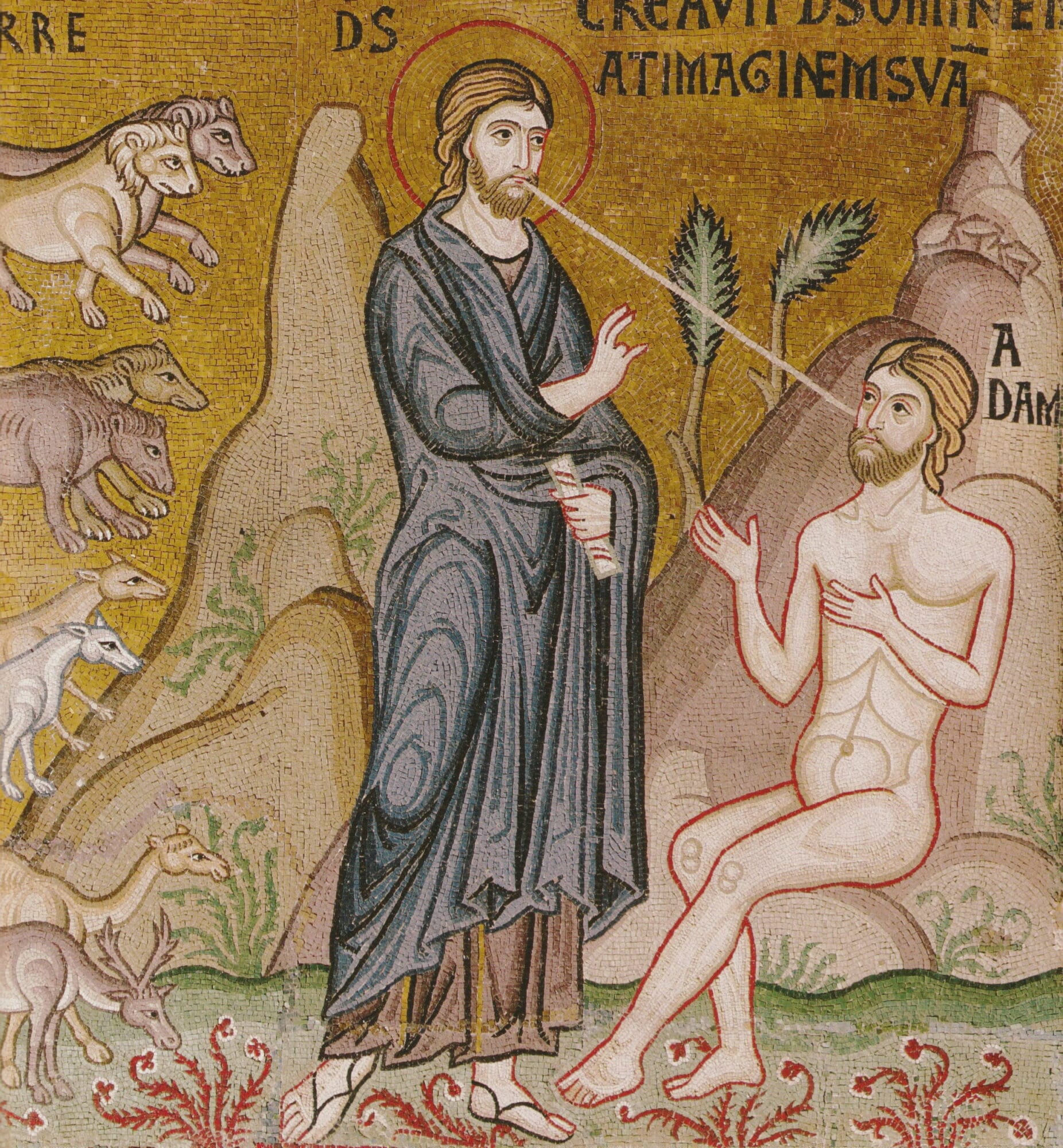
The Creation of Adam. Mosaic, Palermo, Sicily, 12th century.
Awe and silence is therefore the proper end of a sacred image. This is the awe of worshipful wonder that arises when one stands before the brilliant darkness of He who is both in all things and beyond all things.
Most of us are probably idolators to one degree or another, for we limit God to His images, especially the images in our mind. A mental construct is an image. An ideal is an image. Even a true doctrine is an image.
Why do we limit God thus? Perhaps because it is difficult to stand on the edge of an ocean cliff and gaze out at what cannot be known. We stand on what can be known and are afraid of jumping into the unknown, to fly like the eagles that we are. ‘The woman was given the two wings of a great eagle, so that she might fly to the place prepared for her in the wilderness’ (Rev 12.14). We forget that we are creatures with wings of spirit as well as body and brain, that we have what the holy saints call the nous or the eye of the heart. So we withdraw from the edge and retreat inland to the comfort of walking upon the ground, preferring the limits of sensory pleasure and the tidiness of the rational faculty. We eventually forget or ignore our noetic wings.
But our spirts are restless, made as we are for a journey without end into divine love. So we, majestic eagles though we are, walk in circles on the land in the pretence of travelling. We think technological development is progress. We think philosophical complexities are a journey forward. But because the end of man is deification and not mere improvement, we remain discontent.
The prototype of a holy icon is not only of a higher order than its image: it is of an altogether different order. Man made in God’s image is like God, but God is not like man. There is overlap, but the divine prototype is not merely a larger and more powerful version of us humans. What is beyond the overlap of likeness is a forever incomprehensible otherness.
The divine Creator of the human likeness is beyond all categories. God is not a living being; He is Life. He does not possess being; He is The Being. But He is also beyond all categories of Being. God does not exist; He is existence. He revealed one of His names to Moses in the burning Bush: O WN, Yahweh, the Existing One. And yet even this name is insufficient for it is but an icon, a pointer, an indication of one aspect but not of the whole.
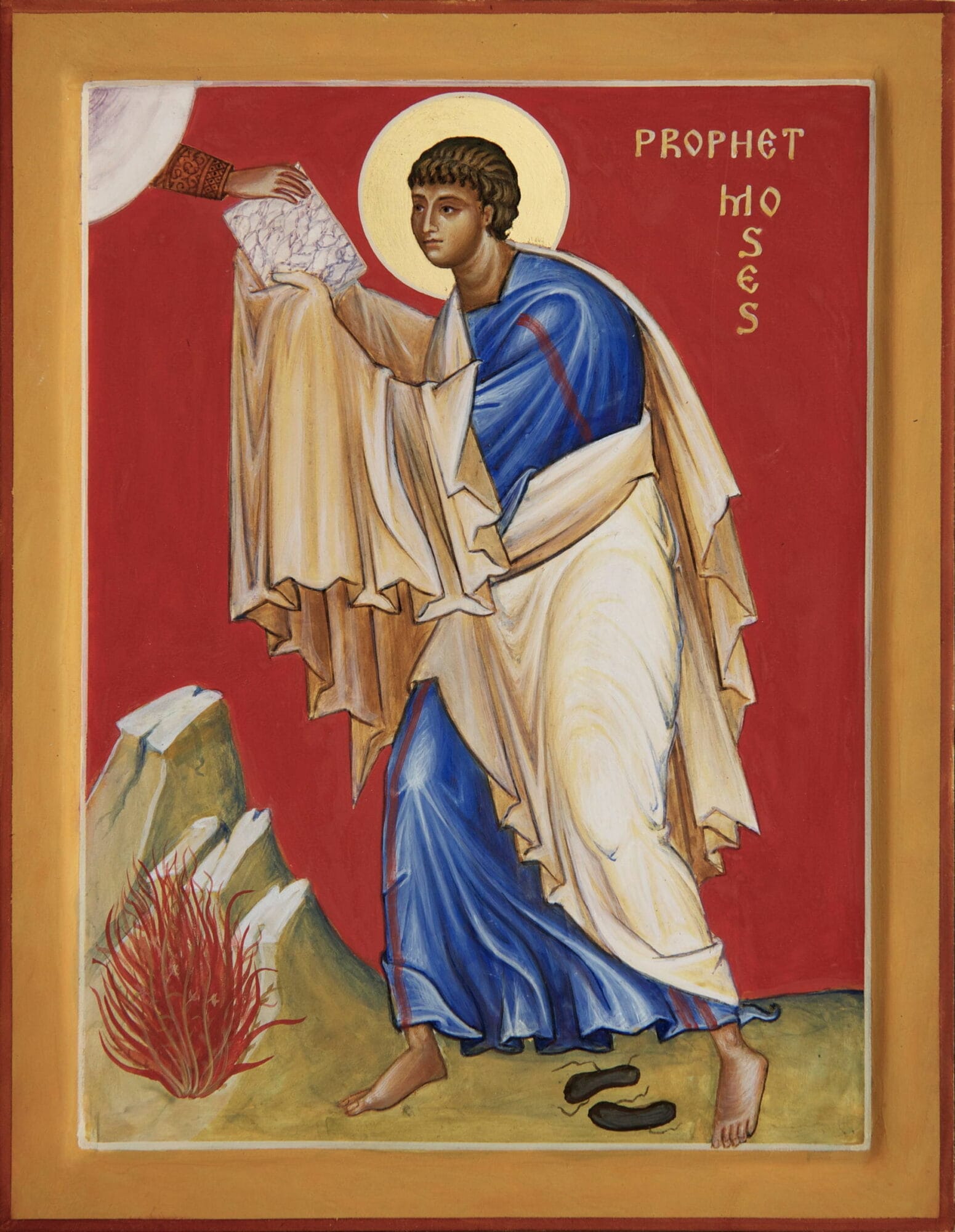
Moses and the Burning Bush, by the author.
This divine otherness is what the Greek theologians call the divine essence, God’s ousia. God in His essence remains forever unknowable, even to the highest angels, and even in the age to come. Every time we say God is this, we need to say that He is not this. He is love, yet He is beyond our limited conceptions of love. His actions confound us, because His wisdom and love are beyond the horizon of human gaze.
But God is beyond even negations. St Dionysius the Areopagite asserts that while affirmations and negations can be applied to things that follow God, neither ultimately can be applied to God as He is in Himself. He transcends all affirmation and transcends all negation:
For he himself solidly transcends mind and being. He is completely unknown and non-existent. He exists beyond being and he is known beyond the mind. And this quite positively complete unknowing is knowledge of him who is above everything that is known.[1]
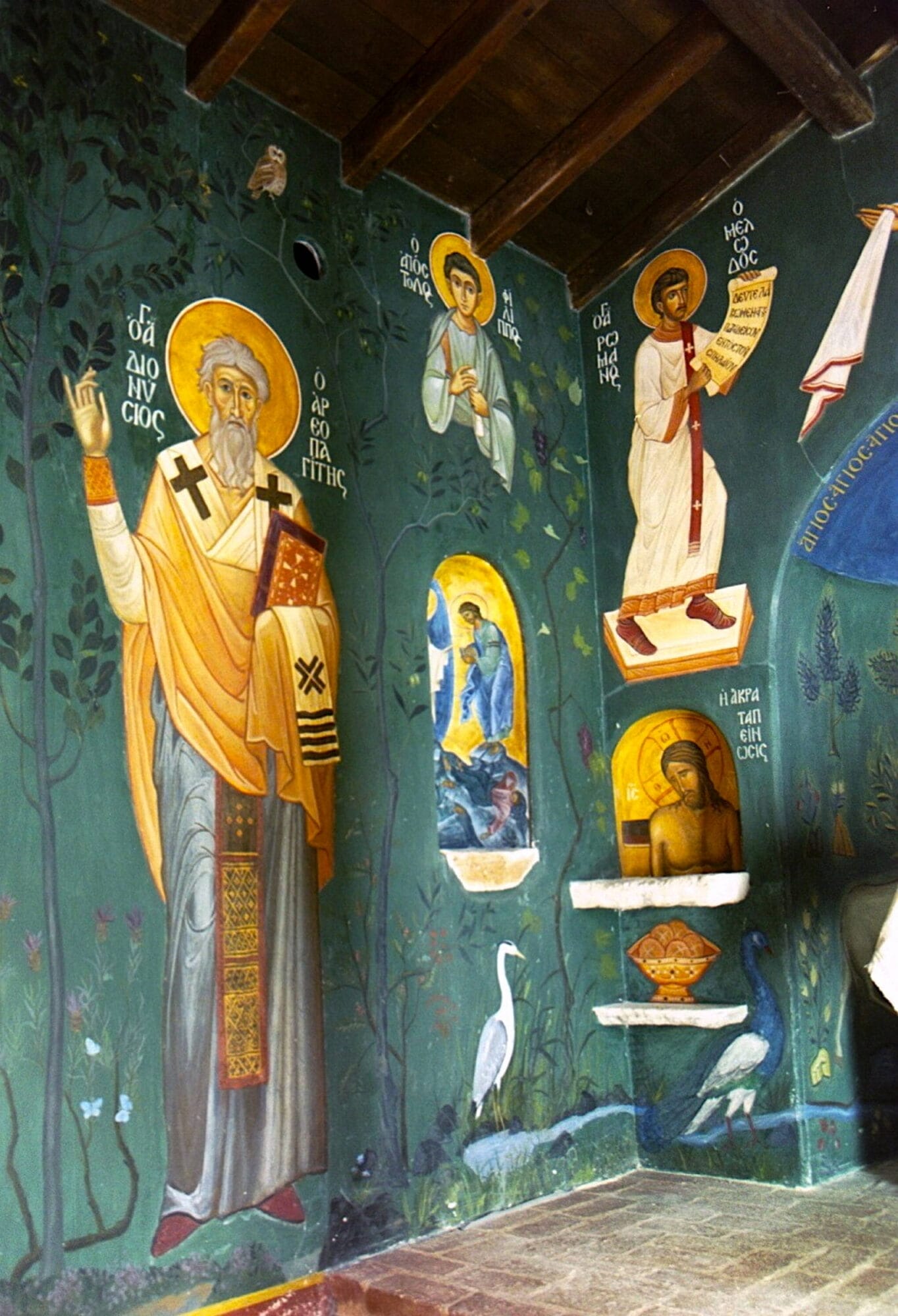
St Dionysius the Areopagite. Fresco, chapel of the Protecting Veil, Evia, Greece, by the author.
The Church’s liturgy is participation in heavenly worship, so its forms reflect something of heavenly realities. However, its forms are simultaneously unlike heavenly realities. The Liturgy’s images ascend beyond our limitations more than they descend to our limitations; they are more apophatic than katophatic. Are the four living creatures of Ezekiel and John’s visions really like an ox, a lion, an eagle, and a man with wings? Are the Ophanim really wheels with eyes? These bizarre images are there not to tell us what heaven is like, but to convince us that it is beyond imagining.
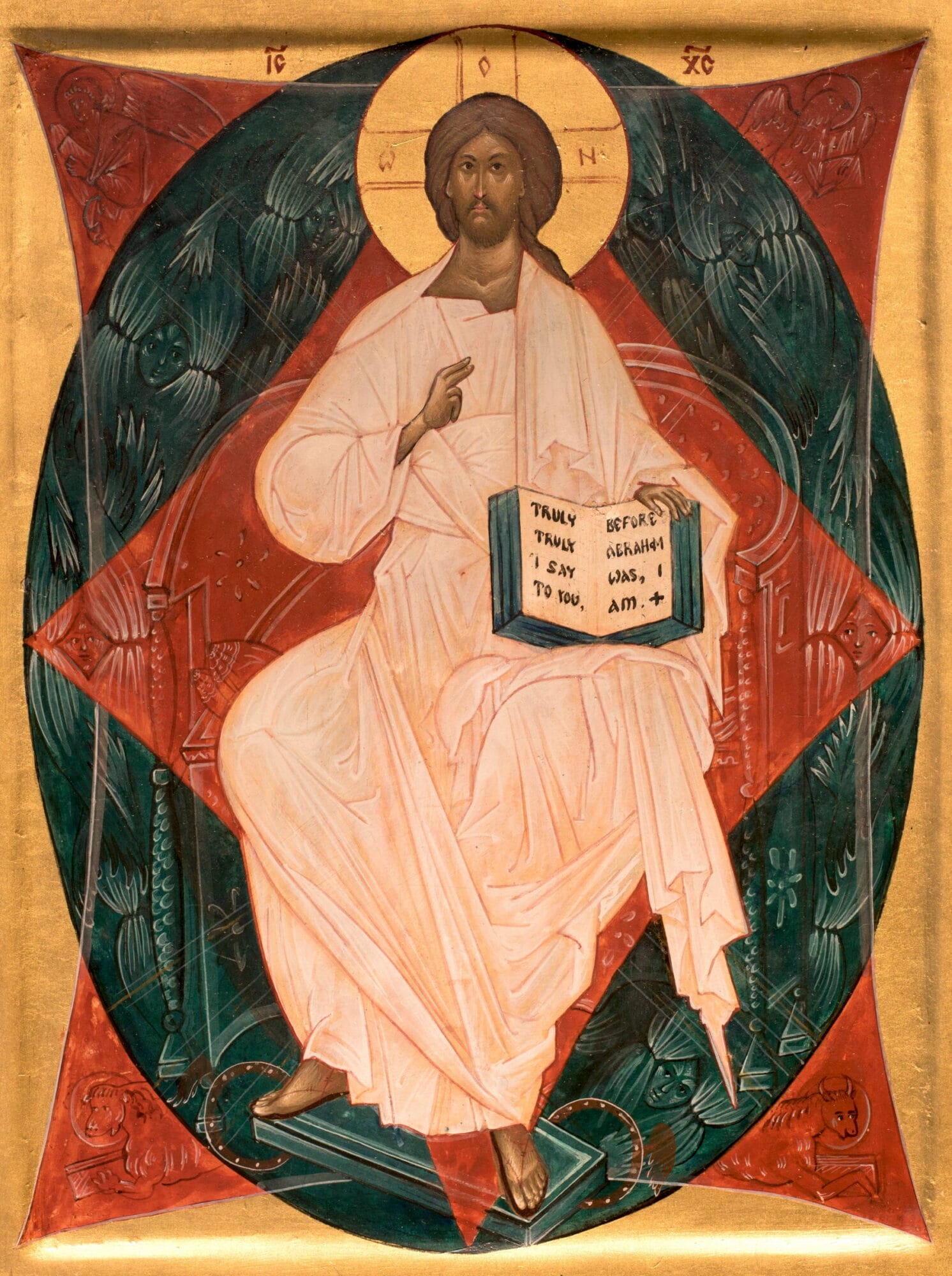
Christ in Glory, with the four living creatures, seraphim and ophanim. Icon by the author.
When the Prophet Ezekiel describes his terrifying vision of heaven (Ezekiel 1) he goes to great lengths to distance himself from the very images that he uses to describe his experience. He repeatedly uses phrases like: ‘what looked like’; ‘what appeared to be’; ‘like the appearance of’; ‘the appearance of the likeness of’.
There is nothing comforting and containable in Ezekiel’s vision. The opening chapter begins with ‘a violent storm coming out of the north – an immense cloud with flashing lightning and surrounded by brilliant light’ (1.4). And it ends with the prophet falling face down in fearful awe: ‘This was the appearance of the likeness of the glory of the Lord. When I saw it, I fell face down, and I heard the voice of one speaking’ (Ez 1.28).
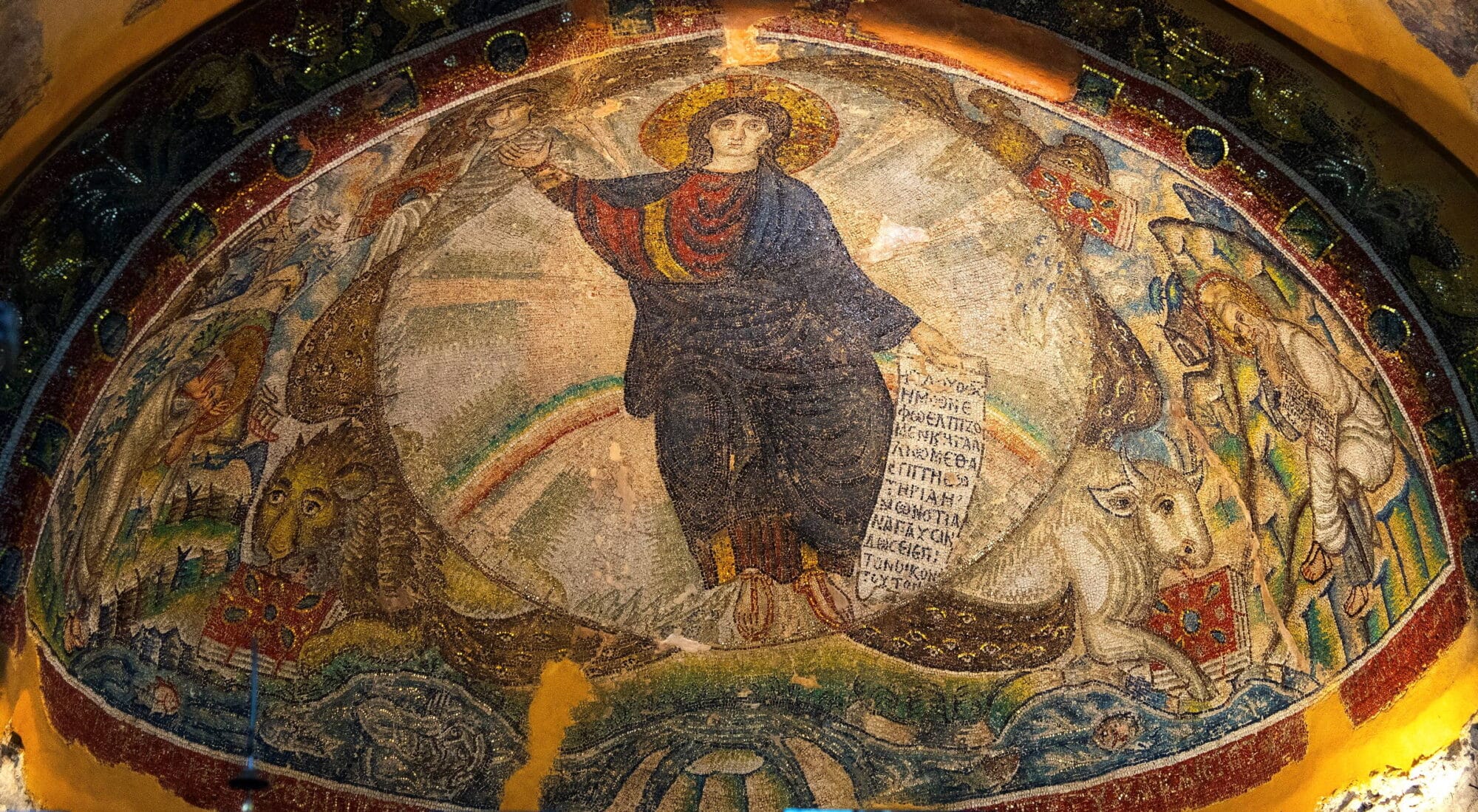
Ezekiel’s vision. Mosaic, late 5th century, Osios David, Thessaloniki.
This otherness is why all religious iconography has a degree of abstraction in its forms. Such images are as strange as they are recognizable. An image participates in its prototype through its likeness to the prototype. It bears the prototype’s name and likeness and so we associate them with one another. There is something recognizable about the image of the saint; the image has a face and hands, things we can identify. But there is also something about the way these images are depicted that is not recognizable. If the imagemaker were concerned only to make a physical likeness, then naturalism would be the predictable format. If however, the awe of unknowing as well as the comfort of knowing is the iconographer’s concern, then the image’s form has a dual function. This form must surprise us, discombobulate us, remind us that within each stone, tree and person is the great storm of God’s presence, ‘an immense cloud with flashing lightning’.
The voice of the Lord is over the waters;
the God of glory thunders,
the Lord thunders over the mighty waters.
The voice of the Lord is powerful;
the voice of the Lord is majestic. (Psalm 29.3,4)
We said that the culmination of a divine image is the awe that ends in silent wonder. We look at an image to look beyond it. We see an image in a mirror and then turn from it to behold the one reflected. We die to the reflection so that we can live to the person reflected.
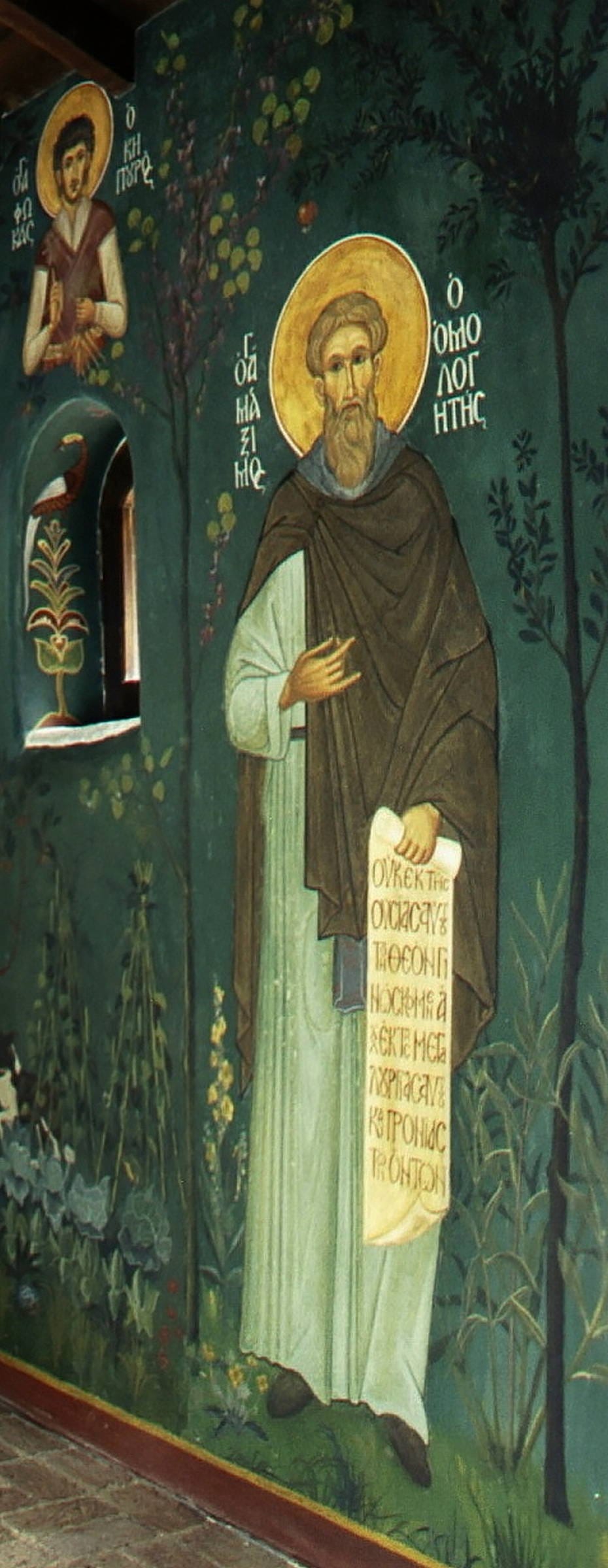
St Maximus the Confessor. Fresco, Chapel of the Protecting Veil, Evia, Greece, by the author.
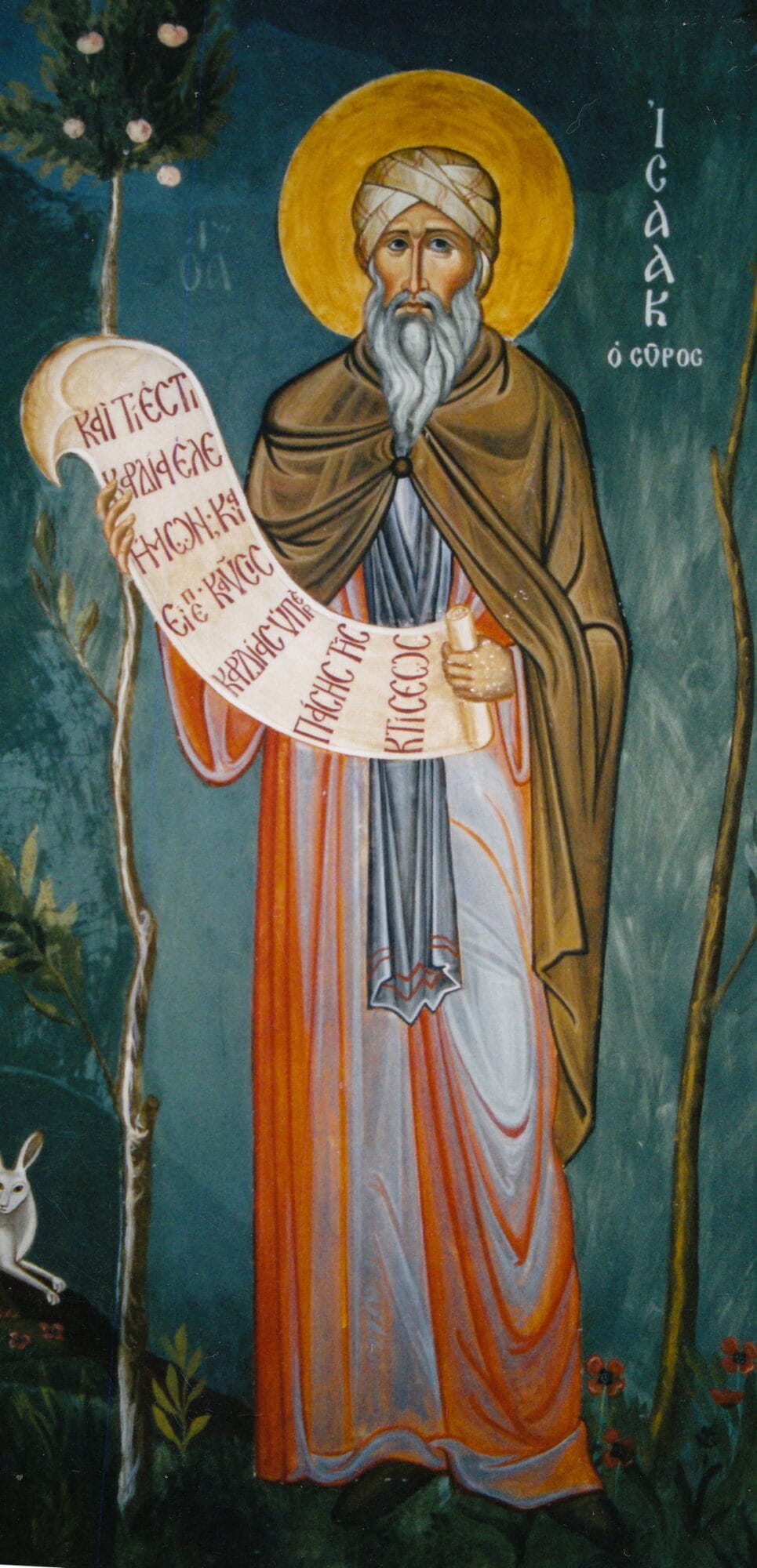
St Isaac the Syrian. Fresco, Chapel of the Protecting Veil, Evia, Greece, by the author.
This turning is what the ascetic writers like St Maximus the Confessor and St Isaac the Syrian mean when they speak of the need to abandon all perceptible things and all objects of thought– not because these perceptible things or thoughts are bad in themselves, or inherently a hindrance, or unnecessary, but because they are a parent whom we must eventually leave so that we can cleave to our spouse. ‘That is why a man leaves his father and mother and is united to his wife, and they become one flesh’ (Gen 2.24).
St Dionysius the Areopagite frequently affirms this progress from seeing the image, to knowing the knowable, and thence to unknowing. But he then presses his readers to advance beyond even unknowing:
The Cause of all…falls neither within the predicate of nonbeing nor of being. Existing beings do not know it as it actually is and it does not know them as they are. There is no speaking of it, nor name nor knowledge of it. Darkness and light, error or truth–it is none of these. It is beyond assertion and denial. We make assertions and denials of what is next to it, but never of it, for it is both beyond every assertion, being the perfect and unique cause of all things, and, by virtue of its pre-eminently simple and absolute nature, free of every limitation, beyond every limitation; it is also beyond every denial.[2]
Perhaps this knowing unknowing beyond sight is why icons of the Transfiguration usually show the most mystic of the Apostles, St John the Theologian, looking away from the physical Christ. His is often also turned inward, as though beholding with the eye of his heart. Like his later adopted mother, the Virgin Mary, he treasured up all these things and pondered them in his heart (cf. Lk 2.19). John is not clinging to the physical presence of Christ transfigured but is looking forward and inwardly to the Ascension of Christ and Pentecost, when He will dwell within him through the Holy Spirit.
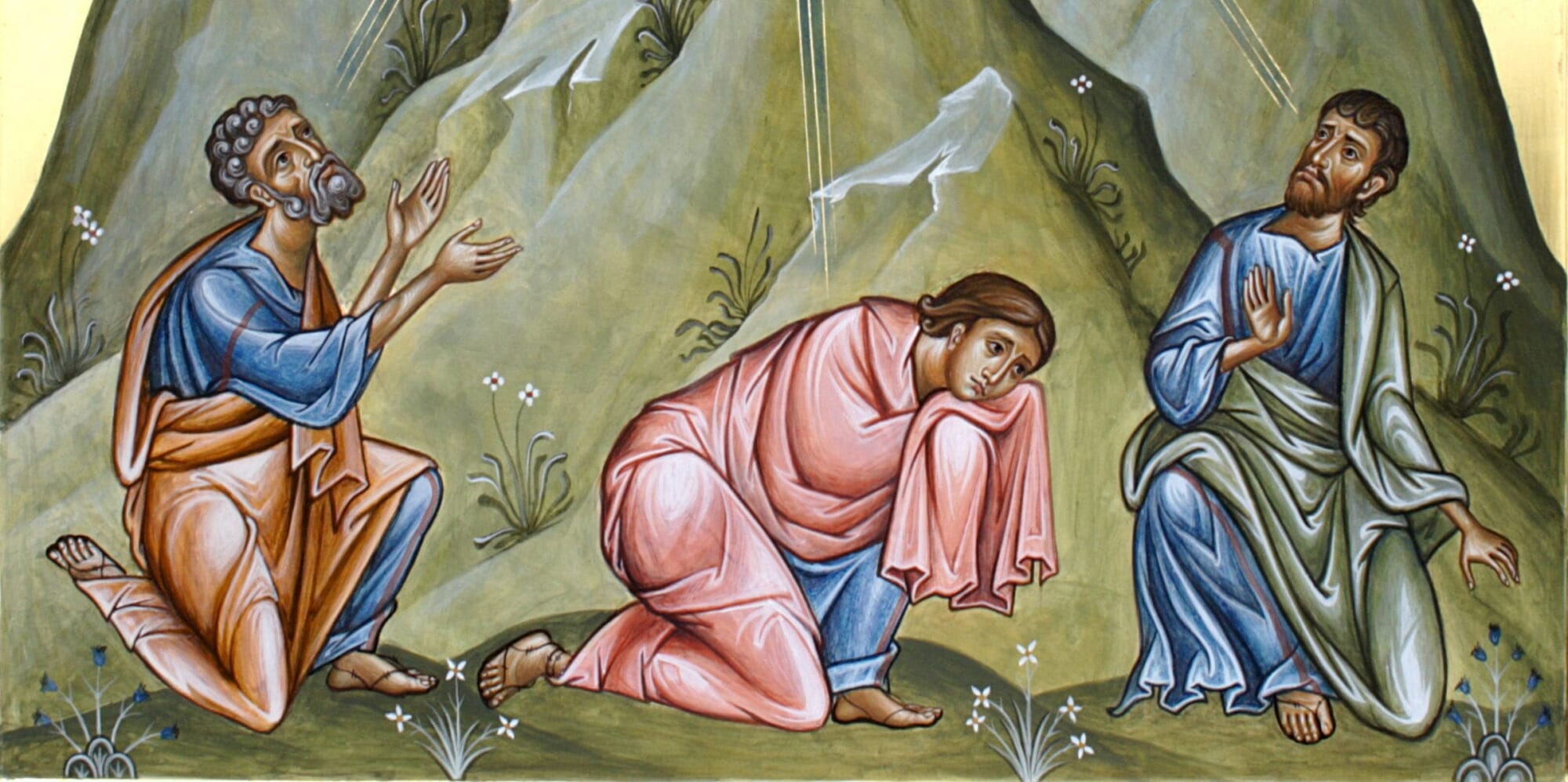
The Apostles at the Transfiguration, detail showing John (centre) seeing by unseeing. Icon by the author.
The paradox of image as both like and unlike prepares us for the live-giving death for which man was ordained and created. Such a death is not the mortality resulting from sin, as real as that is. That death is unavoidable and has nothing to do with our volition; whether we like it or not, mortality will claim us all. This other death, however, is within our volition. We can choose it or reject it.
This life-giving death is to relinquish mere existence in the expectation of a new and divine mode of being. As a monastic saying puts it: ‘If you die before you die you will not die.’
The need for this death and resurrection preceded the fall. Turning from creation towards the Creator givers room for the descent of uncreated Life into the created world. ‘Whoever loves his life will lose it, but whoever hates his life in this world will keep it for eternal life’ (John. 12.25). This phrase ‘for eternal life’ can be better and more literally translated from the original Greek as ‘into life eternal’ (eis zoin aionion). The promise is not therefore to live this current life eternally, where eternal merely means temporal extension. It instead denotes a passing into another form of life, ‘into life eternal’ where ‘eternal’ is an adjective denoting a different mode of being, the divine life. So what Christ speaks of here is not a mere extension of this present order of life, like railway tracks running forever, but an entrance into divine life. ‘Life eternal’ is not just to live forever, but to live divinely, to be deified.
Such deification can only happen through participation in Christ’s humanity. Man can climb a mountain to get closer to God, but the mountain eventually ends, and at its peak God remains infinitely distant. We have exhausted our human brilliance and strength. We can go no further. We have learned humility. It is at this point that God descends to us. Christ’s divinity adopts our humanity. He mingles His body and blood–which is also our body and blood–with His divinity. In Christ and in Christ alone is created life perfectly united with uncreated Life.
Humility as the portal to grace is why so many epiphanies, like the Transfiguration, have occurred on mountain tops. It is not that the recipients have earned this epiphany by some great ascetic feat of climbing, whether metaphorical or actual. It is rather that at the peak they have exhausted their human capacities, and they acknowledge it. They now have room for divine action.
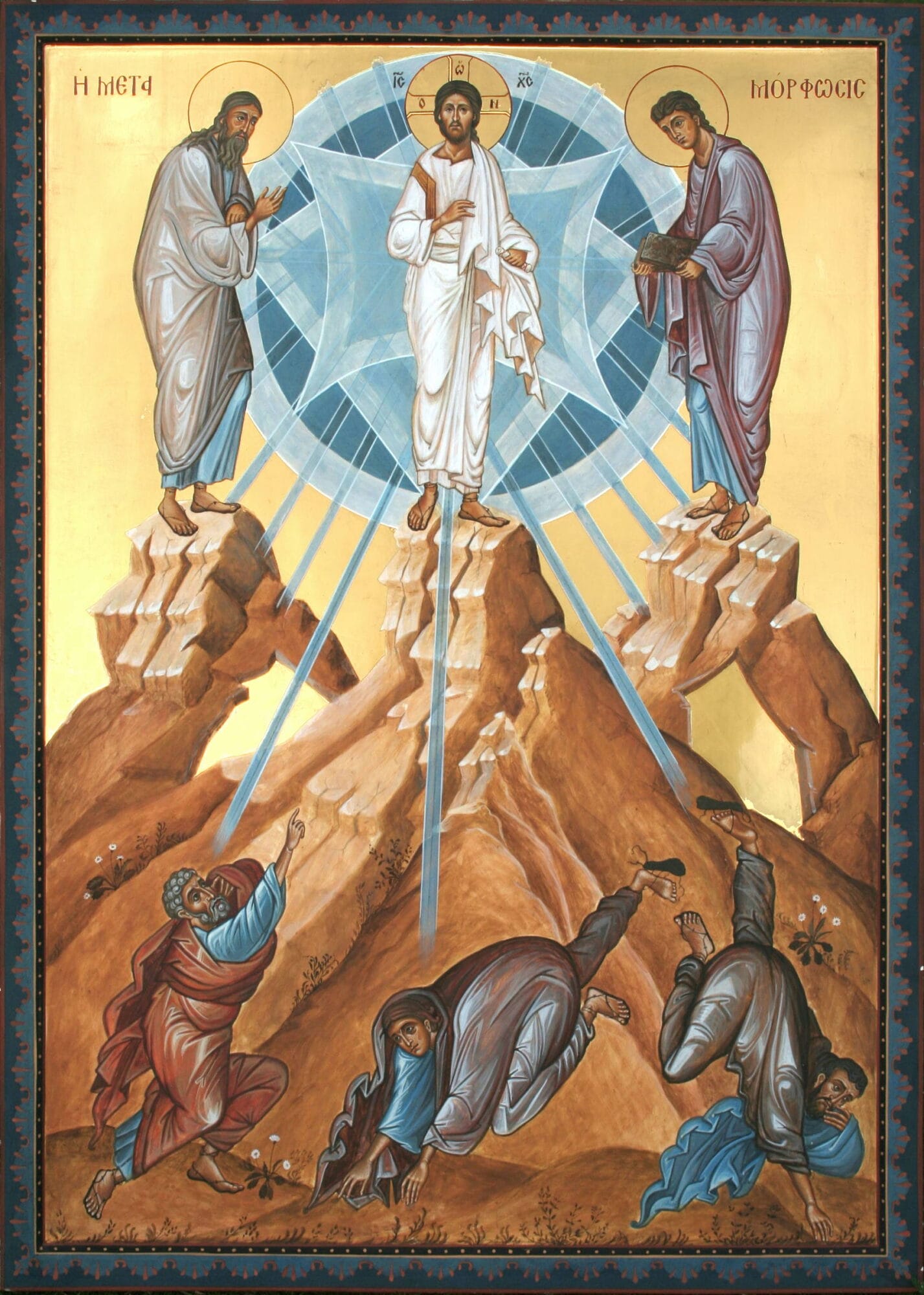
The Transfiguration, by the author.
The theophany granted them is always frightening, precisely because it surpasses any human category. It is new, it is novel, it is other than anything they have known. ‘You should dare to sacrifice everything,’ writes the blessed Archimandrite Vasileios, former abbot of Iviron, Athos, and recently reposed…
You should melt, you should arrive consciously at non-being; and out of that sacrifice should rise something different, eternal, something not constrained by corruption, by passing glory or by your righteousness which is ‘like a polluted garment’ (Isa 64. 6. LXX).
And this ‘something different’, something unfamiliar and alien to your own self (which it may ignore and despise) is your true self and your real existence.[3]
By participation in Christ’s humanity, we created beings become uncreated. How has this come to be? Jesus Christ of Nazareth’s hypostasis or personhood is that of the Second Person of the Holy Trinity. In this His single divine person He united His divine nature to our human nature and thereby deified our nature.
Humans are the opposite. Like Christ, each of us is a single hypostasis–Peter, Jane, Justin– but unlike Christ, ours is a created hypostasis. Like Christ, we possess a nature, but unlike Christ, our natural nature is created and not divine. Like Christ, we are destined to unite two natures, divine and human, only that we are ordained to direct our journey in the opposite direction; He as God adopted our created nature, while we as creatures are called to adopt His divinised nature and thereby participate in His divine life. As the Apostle Peter affirms:
His divine power has given us everything we need for a godly life through our knowledge of him who called us by his own glory and goodness. Through these he has given us his very great and precious promises, so that through them you may participate in the divine nature…(2 Peter 1.3,4)
Through reception of the Holy Spirit we then live forever within this mystery of otherness. We bear this otherness within ourselves in the Person of the Holy Spirit. We bear the divine dark cloud of unknowing as well as the divine lightning of knowing.
It is therefore imperative that each person and community keep walking ever deeper into this mystery, passing from glory to glory, from knowing to unknowing, and if they can bear it, beyond even unknowing. To do this requires the daily refutation of idolatry, never to regard divine life as merely a larger version of our humanity, nor of anything created.
The words of Christ: ‘Whoever loves his life will lose it, but whoever hates his life in this world will keep it for eternal life’ (Jn 12.25) were spoken just before His crucifixion. But what does Christ call this pending crucifixion? ‘The hour has come for the Son of Man to be glorified’ (Jn 12.23). Glorified. Not ‘to die’, though He will, but ‘to be glorified’. The death of the Son of Man is His glorification. Why? It is not the Son of God who needs glorifying, for He is Himself that glory. It is His adopted human nature that needs glorification. It is the Son of Man who is to be glorified. This is why in icons the sign above the crucified Christ reads ‘The King of Glory’. This is why the saints can say, along with the Apostle Paul: ‘I have been crucified with Christ and I no longer live, but Christ lives in me’ (Gal 2.20).
Christ’s coming was not therefore only to mend the fall, to get us back on track. It was not only a divine repair job. Humanity was created for this glorifying death. We were created to journey, to pass from mere existence into divine life.
Christ explained this life-giving death by using the image of a seed dying in order to be transformed into a tree. A seed is inanimate potential. Its cells are dormant. It exists but is not yet living. It is potential, like a movie projector is only potentially so until electrical energy surges through it and animates it. It is only by the seed’s participation in what is other than itself – water, air, and the sun’s rays – that it transcends what it was and is transformed into a living tree. This surely is why so many cultures use the tree as an image of deification; a tree is made of minerals from earth and light from heaven.
This dual nature of the created order, of matter’s transfiguration by divine light, in part explains the mysterious forms of traditional liturgical art and architecture. The way an icon is painted compels us to transcend the mere material. Its perspective lines converge not in itself, but in the liturgical space before it. It is in this ritual space that God and man are united through the Liturgy. Matter is good, though not in isolation but as infused with grace, as a bush burning but not consumed, as the setting for a great drama.
But God transcends even the Liturgy. He both works in that Liturgy and is beyond it. Each image calls us beyond itself so that we can continue to pass from glory to glory.
This is not to say that images are not needed. Images are needed because God made us a psychosomatic unity. ‘The physical first and then the spiritual’ (1 Cor 15.46), as St Paul affirms. The material world is a temenos, a threshold, a holy place. It is where the ladder is planted, but this ladder reaches upwards to heaven. Just as we take our transfigured bodies with us into eternity, so these material images are raised with us and in us. We have no conception of what form matter will take in the age to come, but that age will include matter.
What is certain is that the saints look not at these created images as much as they look at Christ adorned with them, for the transfigured cosmos is the garment of Christ’s Body. His Body, the Church, is the woman clothed in the sun, as seen by St John the Theologian: ‘A great sign appeared in heaven: a woman clothed with the sun, with the moon under her feet and a crown of twelve stars on her head’ (Rev 12.1).
This new modus operandi of the created order, its divine-created nature, explains the importance of light and shadow and of space and form in church architecture. It is why traditional churches have hidden recesses that only open as we move about. What is not manifest as well as what is manifest is imperative to this new life. The space of ‘what is not’ is as important as the material form of ‘what is’. Dark cloud is twinned with lightning.
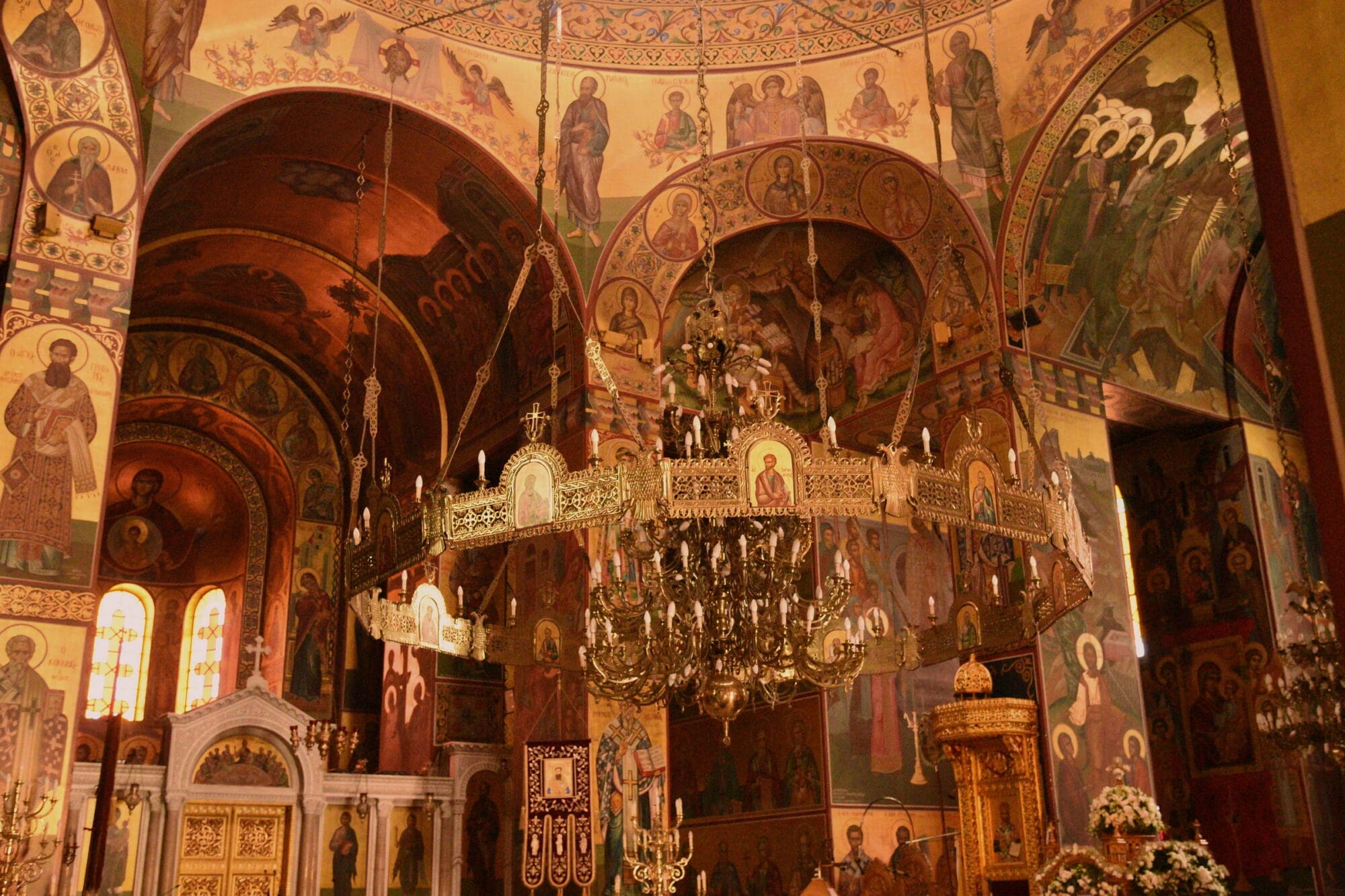
The play of light and shadow in church interiors. Cathedral of St Gregory Palamas, Thessaloniki.
Another way of understanding the imperative of this glorifying death is thanksgiving. To give thanks is the paramount work of mankind. This is why the Eucharist lies at the heart of Christian life, not just as a weekly ritual, but as a complete way of seeing and acting. If Adam and Eve had offered thanks for all the good things God had given them they would have participated in life and not death, in good and not in evil.
To give thanks for all things is to shift one’s gaze from the gift to the uncreated Giver. By thanksgiving we never cease to behold Christ the Giver through and in His gifts. The gift then becomes the garment of the transfigured Christ, transfigured with Him. The world reveals itself as cosmos or adornment. Through thanksgiving we know the cosmos as a theophany and not a thing. The created gift of existence then participates in uncreated life. We die to the gift so we can continue to behold the Giver. This is why some ancient images of the Nativity, such as the fourth-century ‘Dogmatic Sarcophagus’, contrast the Fall of Adam and Eve with the Magi offering gifts to Christ. The wise men acknowledge Christ as their Creator, as the Creator of their gifts, and as the Creator of the star which led them to Him.
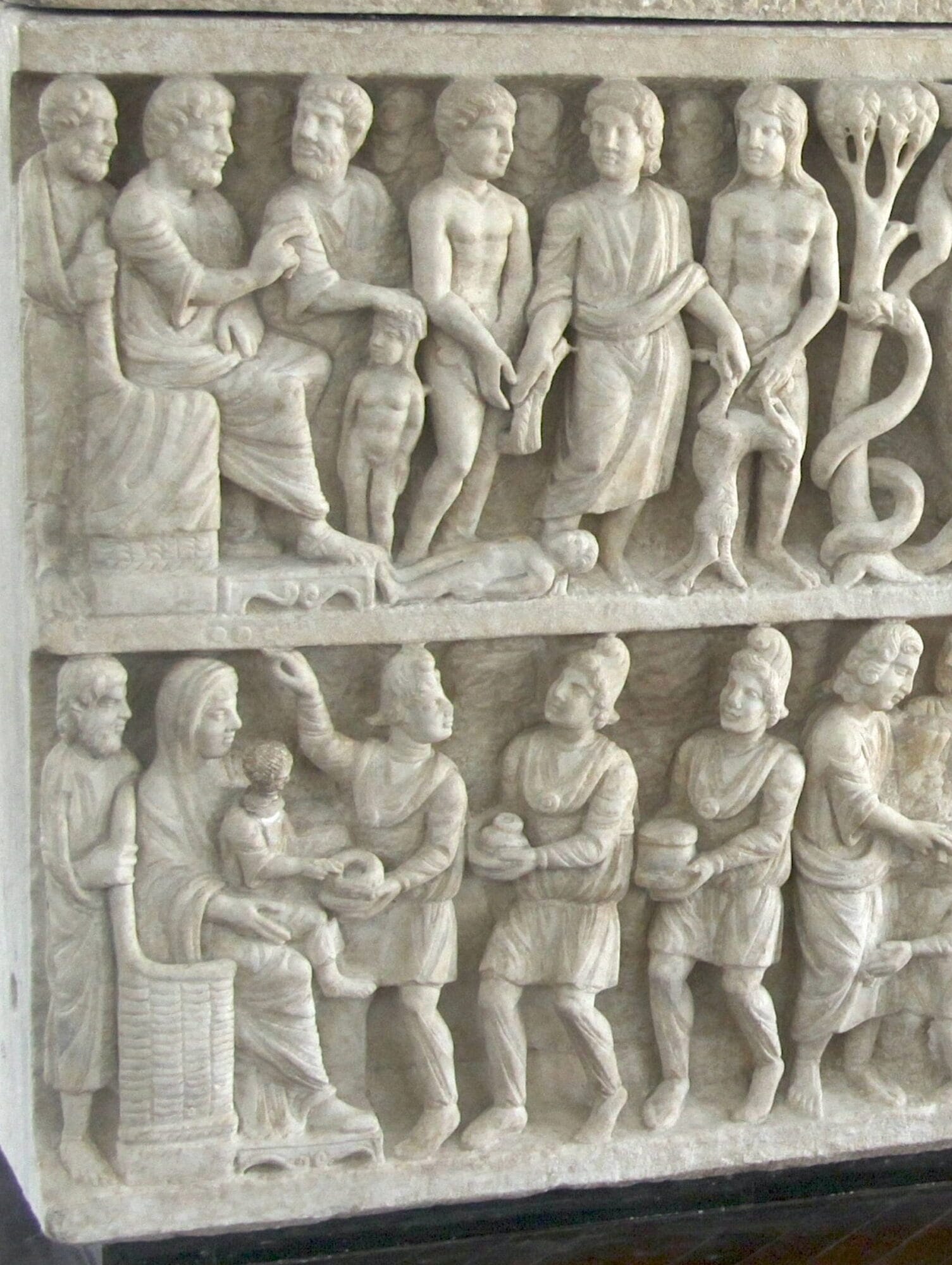
11. The disobedience and grasping of fallen man contrasted with the obedience and thankfulness of the Magi. The ‘Dogmatic Sarcophagus’, 325-350, Vatican Museum.
This eucharistic principle applies to how we respond to circumstance as well as to things. Through thanksgiving, disasters are revealed as glorifications, and worldly success as inconsequential. ‘Rejoice always, pray continually, give thanks in all circumstances; for this is God’s will for you in Christ Jesus’ (1 Thess 5.16-18). God does not create disasters, but He is present in and through them. Sacred iconography is sacred precisely because it manifests events in their sacral meaning. Icons are prophetic. We see how the wretched end up in the bosom of Abraham, and the hard-hearted rich of this world in Hades. Icons reveal the unfortunate as fortunate, worldly prosperity as vacuous.
Liturgical art is therefore more than a mere tool for private devotional practice. It is a training ground, urging us to see ourselves and every single thing as a stamp or reflection of Him who is beyond all being. Even our created spirit, as miraculous as it is, is but a poor image of the Holy Spirit, who is beyond any category. He is both closer to us than we are to ourselves, and beyond us as far as the east is from the west.
The second-century St Irenaeus of Lyon was emphatic that God created time so that humans could advance from being creatures to becoming gods by grace, from being flesh, to becoming light-bearing flesh. This is why we were created not so much in the image of God the Spirit, but in the image of the incarnate Logos. It is why icons of the creation often depict the Creator as Christ, as in the twelfth-century mosaic in Monreale, Sicily. The incarnation of the Logos and His subsequent death and resurrection were not a plaster to mend fallen man’s predicament, or to satisfy the requirements of the Father, whether conceived as a debt of honour, as Anselm of Canterbury insisted, or as the appeasement of divine wrath, as many Reformers contended. The incarnation of God in the flesh was foreordained before man fell, and even before he was created. Man is made in the image of the incarnate Word.
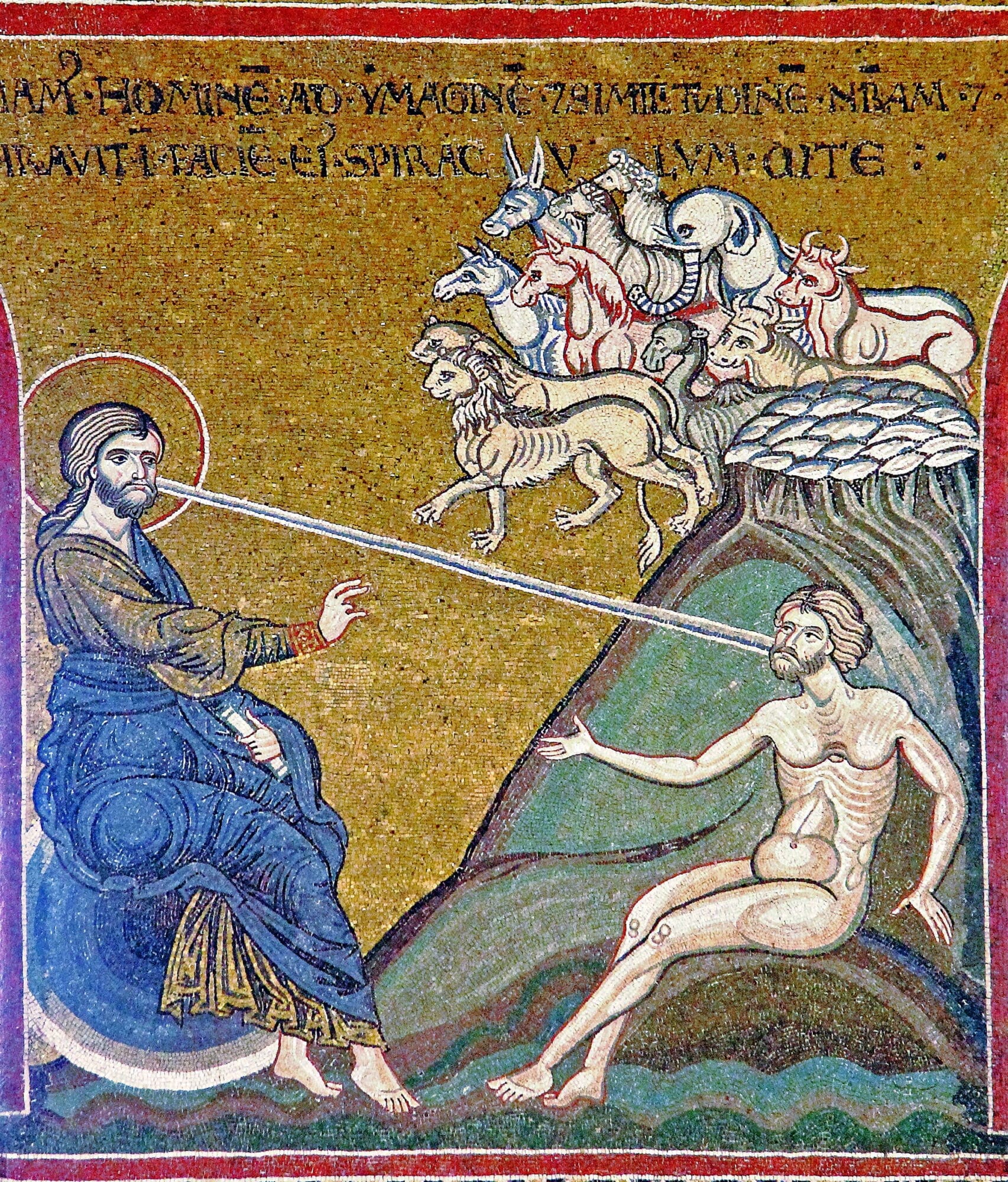
12. Christ the Logos Creates Adam. Mosaic, Monreale, Sicily 12th century.
God could not create man uncreated, a logical impossibility, so He had to create him with the potential to grow into uncreated life. And this could only happen through participation in the divinised humanity of the God-man Christ, the theanthropos.
Christ’s salvific work did not end at His resurrection. His ascension and the descent of the Holy Spirit were an integral part of the Father’s plan. The disciples had to cease clinging to Christ’s bodily form so that He could ascend. And why did He need to ascend? So that He could take their human nature with Him to seat it at the right hand of Father. Only then was human nature ready to receive the Spirit of Truth to make humans into gods by grace. ‘But very truly I tell you, it is for your good that I am going away. Unless I go away, the Advocate will not come to you; but if I go, I will send him to you’ (John 16.7). Only through the Spirit can we experience the Son of Man as also the Son of God.
Man’s destiny as a spiritual animal on a journey towards divinity is why freedom is central. To move forward is to love, and to love we must be free. But modernity has made an idol of freedom. It has divested freedom of its telos and treated it as object–just as did Adam and Eve by eating the fruit of the tree of knowledge of good and evil.
Secular modernity has chosen to ignore the question: Freedom from what and freedom for what? This freedom was given for us to embrace divinising death through thanksgiving, so we could acknowledge that life does not reside in created things of themselves but only in the Creator. Freedom is given for a task, not for possession.
To make freedom a virtue of itself leads only to tyranny. My freedom of action then suppresses another’s freedom. The dignity of the human person when appropriated as a right also leads to idolatry. Man is not the measure of all things; God is. Man’s profound dignity and majesty are granted him from Above. He is an icon of majesty, not the archetype of majesty. He is royal by anointing, not by right.
This willing death is also called repentance or turning–metanoia in the Greek. Repentance’s initial act is to turn from bad actions to good actions, from darkness to light. But after the consequent purification there is then the turning from the good to the very good, from the reflection to the one reflected, from image to prototype. This is the passage from glory to glory.
This passage is why the ‘how’ of our images is as important as the ‘what’ of our images. The form of sacred icons must awaken a sense of awe, must suggest boundaries beyond the known. Like the images of the living creatures in Ezekiel and John’s visions of heaven, our Church’s iconography must unsay as much as it says. Our iconography and how we experience it must avoid the idolatrous containment of the uncontainable so that we can continually progress from glory to glory. This is why traditional chant is otherworldly, why the icon tradition prefers imperfect flatness to the sweetly modelled, tear-dropping hyper-realism of the Spanish Baroque.
For St Isaac the Syrian, humility is the last gate and threshold of human life, for through it we enter divine life. This is not only the humility of knowing one’s sins, as necessary as this is as the first stage in the journey. It is ultimately the humility to know that all we have is granted from above, and all that passes away was mortal and of limited worth anyway: ‘Even if heaven were to fall and cleave to the earth, the humble man would not be dismayed.’[4]
Such humility was possessed by the sinless Mother of God. Even Christ Himself says that He is ‘humble in heart’ (Matt 11.29). How could the Creator of all things be humble? Because He knows that He does nothing of Himself, but of the Father: ‘By myself I can do nothing; I judge only as I hear, and my judgment is just, for I seek not to please myself but him who sent me’ (Jn 5.30). Sacred iconography expresses this humility in its deliberate imperfections, its flatness, its simplifications.
We are material beings as well as spiritual and so need material images to cross to the beyond. We are creatures of symbols. As beings made in the image of the Holy Trinity we are created for relationship, and we need images to begin the journey of knowing. Even a face is an image of the whole person. But to know someone is also to respect their otherness, their mystery. For this, our icons and how we perceive our icons need to know their limits. We need to supersede knowing and enter the realm of unknowing. This is an ignorance embraced, a darkness that is full of light. In the opening hymn of St Dionysius’s The Mystical Theology:
Trinity!! Higher than any being, any divinity, any goodness!
Guide of Christians in the wisdom of heaven!
Lead us beyond unknowing and light, up to the farthest, highest peak of mystic scripture, where the mysteries of God’s Word lie simple, absolute and unchangeable in the brilliant darkness of a hidden silence.
Amid the deepest shadow they pour overwhelming light on what is most manifest.
Amid the wholly unsensed and unseen they completely fill our sightless minds with treasures beyond all beauty.[5]
Conclusion
A culture is what is worships. If Christians want to transform the culture in which they live they must begin with their worship, their iconography, the beauty of their own house. Our churches and the worship offered within them is the Kingdom of God’s seedbed in the world, its nursery, its paradise garden. Worship exists for God alone, but it has its fruits in the world. It has fragrance, it has pollen and seeds. If worship is impoverished, there will be fewer riches to spread into the world beyond our temple walls. Beauty is not frippery. If worthy of the name, beauty contains the ‘immense cloud with flashing lightning and surrounded by brilliant light’ that Ezekiel beheld.
To create such places, such sounds, such fragrances of worship requires the utmost skill, dedication, study, asceticism, taste, resources. We need more highly trained and gifted liturgical artists. We need seminaries to inspire future priests and influencers to give the proper priority to liturgical art and to train them how to commission it.
This labour, as demanding as it is, produces fruits far beyond the cost of such investment. As in the river of Ezekiel’s vision of the temple, this sacred beauty begins as a small trickle near the temple’s altar, but gathers depth to become eventually a mighty river that ‘brings life wherever it flows’:
I saw water coming out from under the threshold of the temple toward the east (for the temple faced east. The water was coming down from under the south side of the temple, south of the altar… And wherever the river goes, every living creature that swarms will live, and there will be very many fish. For this water goes there, that the waters of the sea may become fresh; so everything will live where the river goes… And on the banks, on both sides of the river, there will grow all kinds of trees for food. Their leaves will not wither, nor their fruit fail, but they will bear fresh fruit every month, because the water for them flows from the sanctuary. Their fruit will be for food, and their leaves for healing. (Ez 47.1, 9,12)
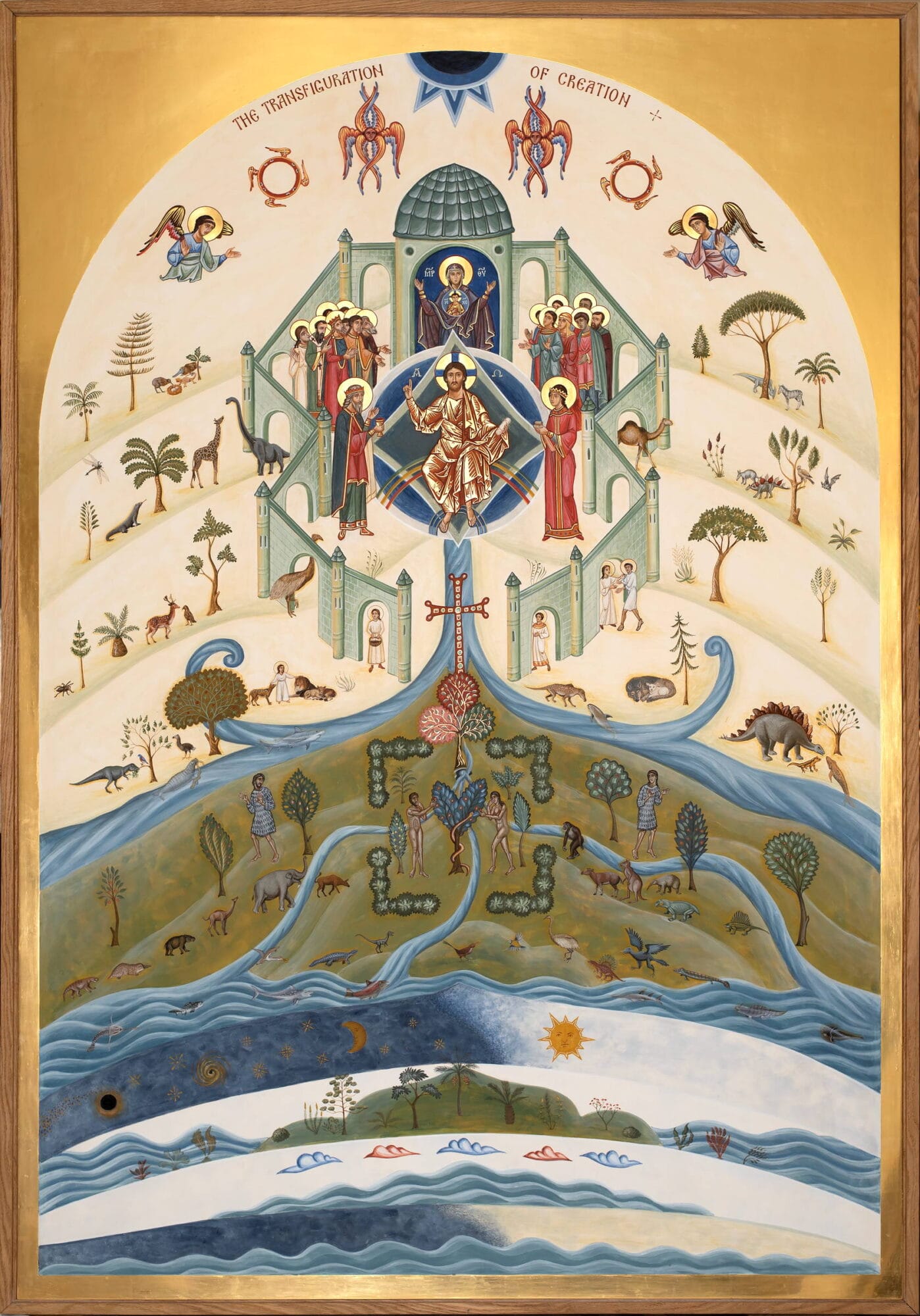
13. The Transfiguration of Creation, showing the life-giving waters coming from the temple. Point Loma Nazarene University, San Diego. By the author.
[1] Pseudo-Dionysios, ‘To the monk Gaius’, Letter One, in Pseudo-Dionysius: The Complete Works, translated by Colm Luibheid (Paulist Press International, 1987), p. 263.
[2] Pseudo-Dionysius, ‘The Mystical Theology’, Chapter 5, p. 141.
[3] Archimandrite Vasileios, Selected Writings, Vol II. (Montreal: Alexandra Press/California: Sebastian Press, 2022), p. 265.
[4] Isaac the Syrian, Homily 72, in Ascetical Homilies of St Isaac the Syrian. (Boston: Holy Transfiguration Monastery, 1985).
[5] Pseudo Dionysius, ‘The Mystical Theology’, Chapter 1, p. 135.
If you enjoyed this article, please use the PayPal button below to donate to support the work of the Orthodox Arts Journal. The costs to maintain the website are considerable.
Thank you for this article, mr. Hart. It really helps me, and is very inspiring. It begs for multiple read throughs and more study.
I hope the work on the new building of your parish is going well. I’ve been thinking about what the ideal iconographic layout for a basilica type church should be, as it is the most common church form where I live.
God bless you, and thanks again for your writing.
This article was very helpful in explaining the role of icons and ourselves as created “images” of God. Thankyou so much!
Leaves me breathless.